


Outdoor Umbrellas
How to Plan a Giant Outdoor Umbrella

Oct
A giant outdoor umbrella can shade a wide area, but its canopy also needs room, a sound fixing plan and clear operating rules. Start with the space and the way people will use it, then check coverage, exposure and product details before you choose a model.
Step 1: Define the Shade Area and How It Will Be Used
Goal: Mark the area that needs shade and decide what must fit beneath it.
Start with the space, not a canopy size from a product page. Sketch the patio, deck, poolside area or venue terrace. Add the furniture and note the routes people use to enter, leave or move between tables.
Then decide what the umbrella needs to cover. A dining area has different needs from a pool lounge or a row of café tables. At home, the main goal might be shade over one table during lunch. For a hospitality venue, staff may need a clear route between seating and the service area.
- Mark the full footprint of tables, chairs or loungers.
- Allow for chairs to move back when people sit down.
- Keep doorways, steps and walkways clear.
- Note where the sun falls at the hours the space is used most.
Use the sketch to decide whether you need one broad shaded zone or a few smaller ones. A single large canopy can work well over a shared lounge area. Several umbrellas may suit a venue where staff need to change the seating layout or keep separate tables in service.
Think about the pole position early. A centre-post design places its support in the area below the canopy, so the table may need a centre hole. A cantilever design holds the canopy from the side, which can keep the seating area clear. That offset support also affects where the base sits and how much space the umbrella needs as it opens.
Consider who will operate it. A family may open the umbrella for afternoon use and close it before leaving. In a venue, staff need a simple rule for who checks conditions and closes each canopy. That daily task is part of the layout, not an afterthought.
For large commercial layouts, treat shade as part of the site plan. Umbrello works with residential, hospitality and public-space projects, so its range includes large-format options as well as cantilever designs. Match the canopy type to the use case, then check the selected model’s current technical details.
Step 2: Measure for Canopy Coverage, Clearance and Reach
Goal: Confirm the canopy can cover the target area without blocking movement or nearby structures.
Measure the width and length of the space you want shaded. If the area is round or irregular, mark its widest points and sketch the outline. Measure the furniture separately, including the space needed to pull chairs out or walk around loungers.
Next, compare those measurements with the canopy dimensions on the product’s technical sheet. Check whether the stated size refers to the canopy’s full width, diameter or another measurement. A square canopy and a round canopy with a similar stated width do not cover a space in the same way.
For a long dining table, check the shade at both ends as well as along the sides. A canopy that covers the table top when the sun is high may leave one end exposed later in the day. If you can, mark the canopy outline on the ground with chalk or tape. That gives you a quick sense of the footprint before you commit.
Allow clearance around the open canopy. Check its distance from walls, fences, branches, light fittings and windows. Then check the full opening and closing path. A canopy may fit when open yet hit a wall or glazing as it folds down.
Reach matters on a cantilever. Measure from the proposed mast position to the far edge of the area you want shaded. Then check the model’s reach and rotation range. The mast and base sit outside the clear shade zone, but they still take up space. Include them in the drawing and make sure they won’t narrow a walkway.
Height needs a check too. Confirm there is enough headroom above the furniture, and consider the umbrella’s clearance when open. For a commercial site, include sightlines to entrances and signs. In a home, check that the canopy won’t block a window you use to see the yard.
Canopy sizes vary by model, so use the selected model’s drawing and dimensions to check actual coverage and clearances.
Write down the measurements before asking for advice. A clear sketch helps a shade specialist check whether the canopy, mast and base fit together in the actual space.
Step 3: Choose the Umbrella Configuration and Position
Goal: Select a support style and location that suit the layout and how the shade will be used.
Choose between a centre-post umbrella and a cantilever system based on what sits under the canopy. A centre post can work well over a table designed to take an umbrella. It may also suit a simple layout where the pole won’t interrupt movement.
A cantilever places the mast to one side. This can keep the space below the canopy free of a central pole, which helps around lounge furniture or pool seating. The trade-off is that the canopy extends from an offset support. The base position and fixing need to suit that arrangement, not just the canopy size.
Set the mast location on your sketch. For a centre-post design, check its fit with the table and the position of chairs. For a cantilever, place the mast where it can reach the target zone without crossing a path or blocking access to a door.
Then check the canopy’s shape against the area. A square or rectangular canopy may suit a long table or a defined seating bay. A round or octagonal shape can fit a central dining setting. The outline matters because the edges determine which seats get shade.
Consider how shade shifts through the day. The sun moves, and the shade line moves with it. If the umbrella has a rotation or tilt function, read the manufacturer’s instructions to understand how that model adjusts. Don’t assume every umbrella has the same range of movement.
For commercial spaces, map the relationship between umbrellas. Overlapping canopies can leave gaps when the sun angle changes, while placing them too close may limit how each one opens. Show staff routes and customer access on the same plan. That makes it easier to spot conflicts before installation.
For a home, test the main use times. If people eat outside in the late afternoon, check the low sun from that direction. If the shaded area is beside a pool, make sure the mast and base don’t obstruct the route between the house and water.
Keep the position flexible only if the chosen model and base are designed for that use. Some installations are planned to stay in one place. Others may suit a movable setup. Confirm the permitted mounting options for the specific umbrella rather than assuming it can be shifted safely.
Step 4: Check Wind Exposure, Base and Fixing Requirements
Goal: Match the umbrella and its fixing method to the site’s exposure and the manufacturer’s instructions.
Look at the site honestly. A courtyard sheltered by buildings differs from an open deck, rooftop or coastal terrace. Note nearby walls or screens, but don’t treat them as proof that the space is sheltered. Wind can change direction around buildings and across open areas.
Wind performance depends on the umbrella model, its setup, the fixing and site conditions. A wind rating is useful only when you understand what the manufacturer says it applies to. Check whether the rating covers the umbrella open or closed, and whether it assumes a specific mounting method.
A wind figure published for one system must not be applied to every Umbrello umbrella or installation. Ask for the current documentation for the exact model and configuration, then confirm the fixing conditions behind its rating.
Choose the base or anchor as part of the system. Depending on the model and site, a freestanding base may be suitable, while a fixed installation may call for a surface plate or an in-ground anchor. The correct option depends on the manufacturer’s guidance and the surface beneath it.
Don’t size a base using a generic canopy-to-weight formula. A large offset canopy places different forces on its support than a centre-post umbrella. The site, mounting arrangement and model all affect the fixing plan. Request the manufacturer’s requirements before construction or purchase.
For a permanent installation, confirm that the planned surface and fixing method are suitable. If the umbrella is going on a deck, slab or paved area, check the structure beneath the visible surface. For a public site, coordinate the fixing plan with the project team responsible for the site and installation.
Set a clear operating limit before the umbrella is used. Follow the manufacturer’s directions for wind and close the canopy when conditions reach the stated limit. In a venue, assign responsibility to a staff role and make the close-down routine part of the shift process.
A wind rating cannot remove the need for correct use. The large-format umbrella wind-resistance guide can help you frame questions about ratings and anchoring before discussing a specific system.
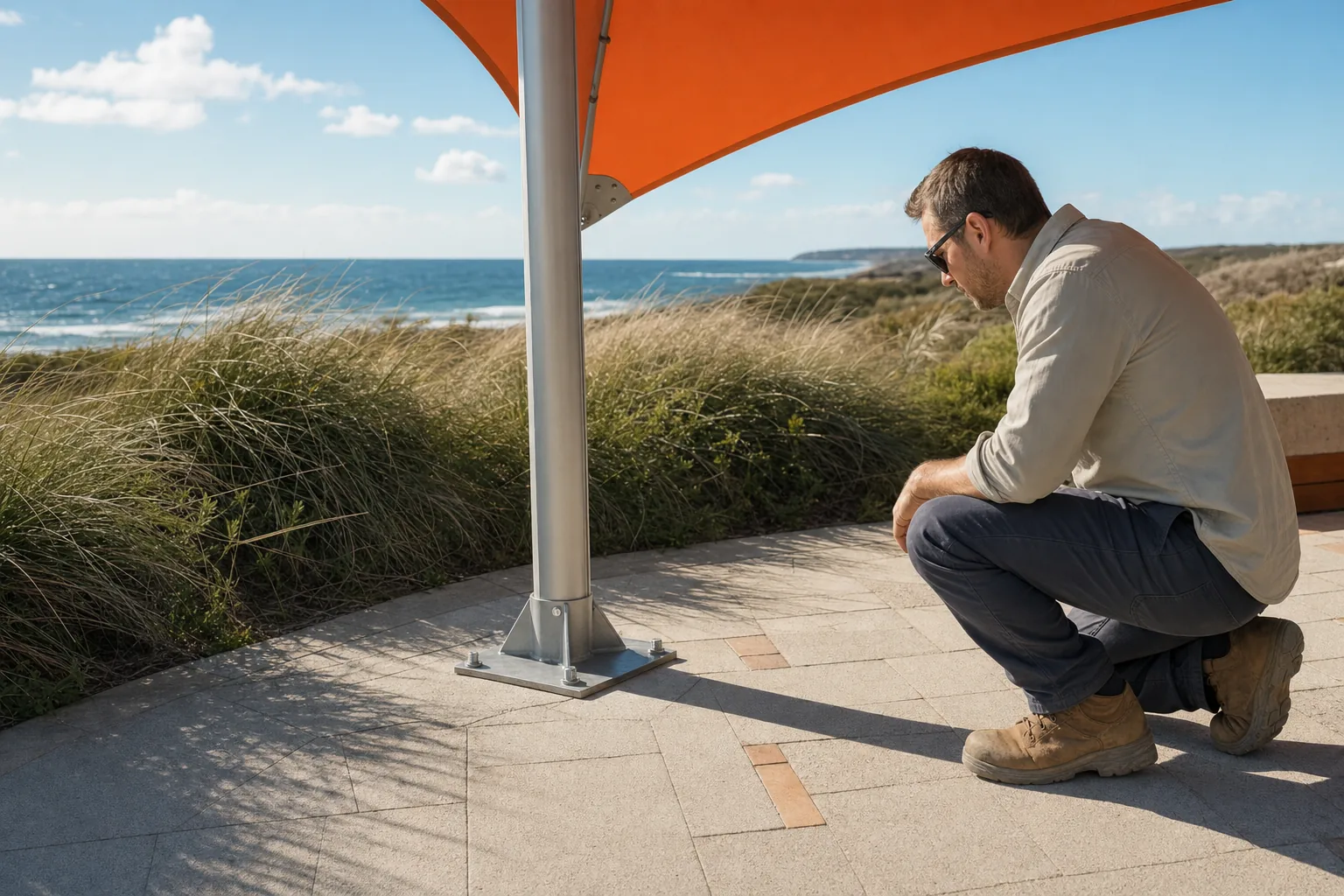
Before installation, put the model name, fixing method and operating instructions in one project file. That gives the installer and the people who use the umbrella the same reference.
Step 5: Review Materials, UV Protection and Product Documentation
Goal: Check the frame, canopy and performance details against the conditions and use of your site.
Start with the frame material. Aluminium is common in outdoor umbrella construction, while some premium systems also use stainless steel or timber components. Each material has its own care needs. If the site is exposed to salt air, ask the supplier which parts and finishes suit that setting.
Don’t stop at the frame label. Check the joints, fittings and moving parts listed in the product information. These details affect how the umbrella opens and closes over time. For a venue where staff operate the canopy each day, ask how parts are serviced and whether the maker provides replacement components.
Read the canopy information with equal care. Look for the stated fabric type and UV protection measure, if provided. In Australia, shade is a key part of sun protection, but an umbrella’s coverage changes with the time of day and surrounding conditions. Don’t treat fabric protection as a substitute for checking the shaded area itself.
Request the technical sheet for the exact product. It should let you confirm dimensions, frame materials, canopy details, mounting options and any stated wind performance. If you’re specifying a project, keep the current version with the plans so the purchase and installation refer to the same configuration.
Compare warranty terms by component. The frame, fabric and finish may have different cover periods or conditions. Read what the warranty covers and what care or use rules apply. A long term on one part does not automatically cover every part of the umbrella.
Umbrello’s range includes Shadowspec cantilever systems and large-format commercial umbrellas. The right choice depends on the project brief, the canopy size and the installation. Ask for details tied to the specific model rather than relying on broad claims about a product family.
Keep a short record of the details that affect your decision:
- Model and canopy dimensions.
- Frame and canopy materials.
- Wind guidance and required fixing.
- UV information and warranty terms.
- Care instructions and serviceable parts.
If an important figure is absent from the document in front of you, ask the supplier for the current specification. Don’t fill the gap with a guess or a number taken from a different model.
Step 6: Plan Installation, Operation and Ongoing Care
Goal: Make sure the umbrella can be installed, operated and cared for as intended.
Before ordering, confirm who will install the umbrella and what the site needs to be ready for. For fixed systems, coordinate the anchor or base with the builder or installer before paving or deck work is complete. For a movable base, check the surface, route into the area and storage location.
Review the opening and closing process with the people who will use it. Make sure the operating handle or mechanism is accessible. Check that the canopy can close without hitting furniture, a wall or nearby planting. If it needs to be moved to close, include that step in the layout plan.
For a business, write a short operating routine. Name who checks weather conditions during the day. State when staff should close the umbrella under the maker’s guidance. Make sure the rule still works during a busy service, when no one has time to hunt for instructions.
For home use, decide where the canopy will stay when it is closed. A cover or sheltered storage may help protect it when not in use, but follow the care guide for the specific fabric and frame. Don’t store a damp canopy in a way that conflicts with the manufacturer’s instructions.
Set a regular check for moving parts and fixings. Look for loose hardware, wear or damage before opening the umbrella for the season. If a part needs repair, use the manufacturer’s recommended service process rather than forcing a stiff mechanism.
Clean the canopy and frame using the product care instructions. Different fabrics and finishes may need different methods, so avoid strong cleaners unless the maker approves them. Clear dirt from moving parts and let fabric dry as directed before covering or storing it.
Keep the technical sheet, warranty terms and care instructions where staff or household members can find them. If the umbrella changes hands between shifts, leave the operating rules with it. That simple handover helps prevent one person’s assumptions from becoming the next person’s risk.
Before the first use, walk through the full sequence: open, adjust if allowed, close and secure. Check the base area and make sure the canopy clears its surroundings throughout the movement. If anything binds or conflicts with the space, stop and resolve it before regular use.
FAQ: Giant Outdoor Umbrellas
How do I choose the right size umbrella?
Measure the full area you want shaded, including furniture and the room people need to move. Compare that footprint with the canopy dimensions and check how its shape covers the space. Then allow for the mast, base, opening path and nearby walls. A measured site plan is more useful than choosing a canopy by appearance alone.
Is a cantilever umbrella better for a large patio?
A cantilever can suit a large patio when you want the area below the canopy free of a centre pole. Its offset mast and base still need space, and the fixing must suit the model and site. A centre-post umbrella may fit better over a table with a pole opening. Choose by layout and use.
Can a giant outdoor umbrella stay open in the wind?
Only follow the wind guidance for the exact model and installation. Wind performance depends on the canopy, frame, fixing and site conditions, so a rating is not a blanket guarantee for every setup. Close the umbrella when the maker’s stated operating limit is reached, and set a clear routine for doing so.
What should I check in an umbrella’s technical sheet?
Check the canopy dimensions, frame and fabric materials, mounting options, wind guidance and care instructions. Review warranty terms by component, too. For a project, make sure the sheet applies to the exact model and configuration being installed. If a detail affects safety or fit, ask the supplier to confirm it in current documentation.
Conclusion
Plan the site before choosing the canopy: measure the shade zone, mark the base and confirm the fixing with the model’s current guidance. For a large residential or commercial project, send your sketch and site details to Umbrello and request advice on a suitable configuration.
