


Outdoor Umbrellas
Coastal Outdoor Umbrellas: Wind Rating Guide
Sep
A published wind rating sounds like the clearest way to choose an outdoor umbrella for coastal areas in Australia. Buyers still need to judge wind performance through the whole setup: site exposure, frame design, canopy fabric, base weight and fixing method.
Use the steps below before you buy. They will help you compare an open beach deck with a sheltered courtyard and decide when a fixed shade system makes more sense than a portable base.
Step 1: Assess Your Coastal Site and Wind Exposure
Choosing an outdoor umbrella with a wind rating for coastal areas in Australia starts with the site, not the fabric colour. Wind load changes with height, nearby buildings and how much open space surrounds the umbrella.
Stand where the umbrella will go and look at the paths wind can take. A roof deck has little shelter. A pool area beside a solid wall may have less direct wind, but gusts can still spill over the wall and swirl around the canopy. Beachfront gardens, headlands and open lawns deserve a cautious assessment.
Write down four details:
- How exposed the site is to the sea or open sky.
- Whether the umbrella will sit on a roof, deck, paving or soil.
- How often strong gusts affect the area.
- Whether staff or household members can close it quickly.
Also note the height of nearby walls and screens. A low screen may cut some wind, while a tall wall can create turbulent air on the sheltered side. The umbrella may feel calm at ground level and still move hard above the screen.
Next, decide how the umbrella will be used. A home owner who opens it for lunch on calm days has a different risk profile from a café that leaves shade in place throughout service. A school, council or resort also needs a clear closing routine because users may change during the day.
Wind reaches the canopy first. The canopy then transfers force into the ribs, pole and base. If one part is weak, a heavy base can’t fix every problem.
For exposed sites, compare three broad setups:
- A portable centre-post umbrella for sheltered use and frequent storage.
- A cantilever umbrella where flexible shade placement matters, backed by a suitable base or fixed mount.
- A permanently fixed structure for open coastal, rooftop or commercial locations.
Keep a simple rule in mind: the more exposed the site and the larger the canopy, the less sensible a light portable base becomes. Advice on windy Australian sites also points to the relationship between frame strength, canopy tension and secure mounting, rather than any single feature.
Step 2: Interpret the Umbrella Wind Rating and Engineering
An outdoor umbrella with a wind rating should state what the number means. Ask whether it refers to a steady wind, a gust, a test condition or a complete installed system.
Don’t compare a stated rating with a vague phrase such as “wind resistant”. Those words don’t tell you the wind speed, test method or base used. Ask the supplier for the rating in kilometres per hour and for the conditions behind it.
Check these points before treating the figure as useful:
- Does the rating cover the full umbrella or only the canopy?
- Was the umbrella tested with a specified base or anchor?
- Was it open, partly closed or fully closed during testing?
- Does the rating apply to a particular size and shape?
- What must the operator do when gusts rise?
A rating is not permission to leave an umbrella open in a storm. Sudden gusts can rise above the stated test condition. Wind can also change direction, which places uneven stress on one side of the frame.
In the 19-item review behind this guide, the wind-rating field was blank for all 19 products. Frame and fabric details were much easier to find. That gap is common enough that buyers should ask direct questions instead of assuming a premium price includes a tested gust figure.
Wind itself is moving air with pressure and force. Wikipedia’s overview of wind explains how wind speed and direction describe air movement, but an umbrella rating still depends on the structure being tested and installed as a system.
Look at the engineering around the number. A stiff pole can pass force into a weak base. A heavy base can shift if the surface is smooth or uneven. A strong canopy can place more load on the frame because it holds its shape instead of spilling air.
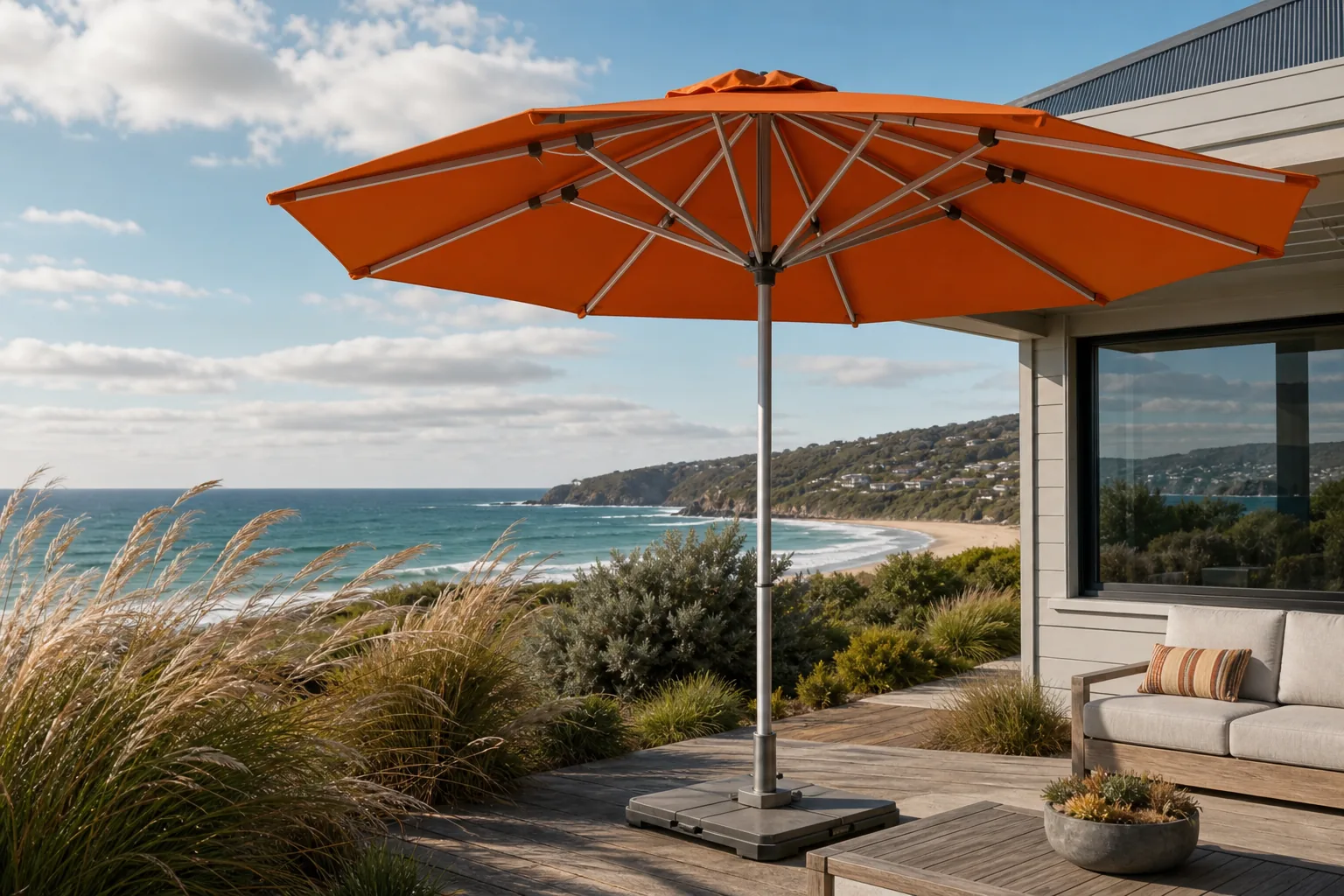
Umbrello is worth considering when you want a specialist to discuss the complete setup rather than a canopy in isolation. Its range includes premium umbrellas for homes, hospitality spaces and larger commercial settings, with attention to durability and design under Australian conditions.
Request written details for the model, size and proposed base. If the supplier cannot provide a gust figure, treat the missing figure as a limitation. You can still assess the product, but you should rely more heavily on installation advice and a conservative closing plan.
Step 3: Choose the Right Umbrella Format, Base and Fixings
The right format for an outdoor umbrella in a windy coastal area depends on how much shade you need and how firmly you can fix it.
Centre-post umbrellas
These work well where the table sits below the pole and the umbrella can be closed after use. They are often easier to store, but the base still needs enough stability for the canopy size and site exposure.
Cantilever umbrellas
A cantilever moves the pole away from the shaded area. That helps with loungers, pool edges and dining layouts. It also creates a longer load path, so the base, crossbar and mount need close attention.
Check the base footprint before you check the colour. A narrow base can tilt when the canopy catches a side gust. A broad base may be safer but can block paths or reduce usable floor space.
For paved or concrete areas, ask whether the umbrella can use an in-ground fixing or a permanent plate. For decks, confirm the fixing method with the builder. Screwing a mount into boards without reaching the supporting structure may leave the umbrella unstable.
For a movable setup, choose a base that can be weighted without making it hard to move during an emergency. An internal link to Umbrello’s cantilever umbrella base guidance can help you compare base types before you set out the space.
Then test the daily routine. Can one person close the canopy? Does furniture block the handle? Will a venue worker need to cross a busy service area to reach it? A shade system that is hard to close may stay open too long.
Don’t treat a portable sandbag as a substitute for a fixed anchor where the site has regular strong gusts. Added weight can help a suitable setup, but it doesn’t change the shape of the canopy or strengthen the pole.
For a coastal café, resort or public space, have the fixing detail reviewed before paving is finished. It is much easier to place a sleeve or mounting plate during construction than to repair a weak surface later.
Step 4: Specify Salt-Resistant, UV-Stable Materials
Materials matter when an outdoor umbrella with a wind rating will live near salt air. Wind creates movement, while salt and sun work on the frame, fasteners and canopy over time.
Aluminium is common because it keeps weight down and doesn’t rust like ordinary steel. It can still corrode in marine air, especially where salt sits in joints or on damaged finishes. Ask how the frame is finished and whether the hardware suits the site.
Steel can provide a strong frame, but untreated or poorly protected steel may rust. Fibreglass can reduce corrosion concerns in some frame parts, though the pole, fittings and base still need review. The material name alone doesn’t prove how the full umbrella will perform.
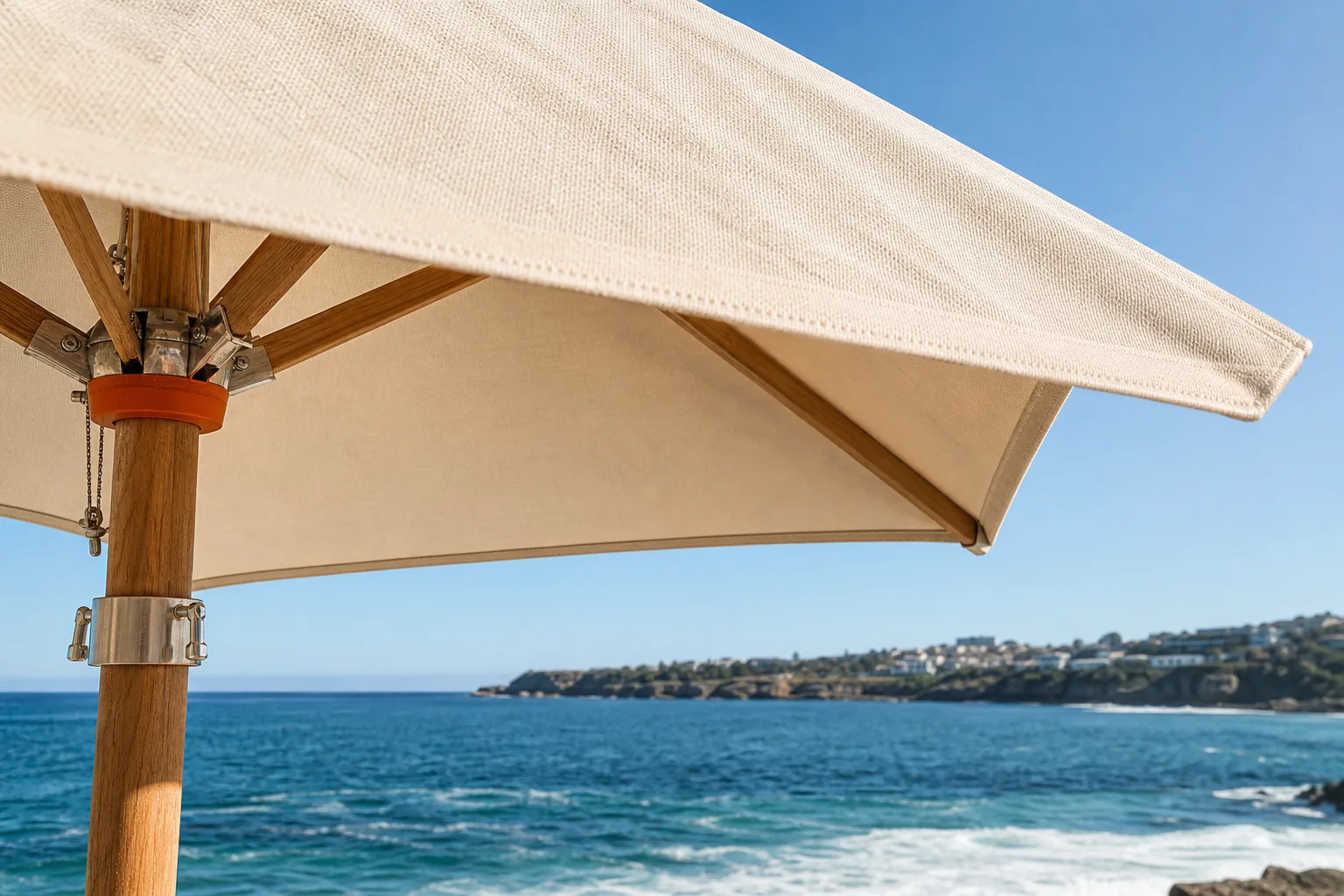
Umbrello’s timber option uses Indonesian teak, a natural material with a warm architectural look. Its UV-resistant acrylic canopy is suited to buyers who place weight on shade fabric durability and appearance. The available product information does not give the canopy a numeric denier rating, so ask for the care instructions and any test data relevant to your project.
In the review dataset, 13 different frame material types appeared. Aluminium was the most common material among the products with a recorded frame detail. Umbrello’s teak was the only natural-wood frame in that set, which may suit a landscape design where metal would look too stark.
Fabric details were also uneven. Twelve of the 19 items listed a fabric specification, with recorded denier values ranging from 300D to 600D. Denier can help you compare fabric weight, but it doesn’t tell you everything about UV stability, coating, stitching or colour retention.
Ultraviolet radiation can damage outdoor materials over time. Wikipedia’s explanation of ultraviolet radiation covers the high-energy part of sunlight that can affect exposed surfaces, which is why UV resistance belongs in the specification review.
Ask for care details in plain terms. Find out whether the canopy should be rinsed with fresh water after salt exposure, how stains should be removed and whether the cover must be dry before storage. Also ask how often the timber should be inspected.
Warranty information is another useful clue, though it isn’t a wind rating. Only three of the 19 reviewed products listed a warranty, so compare the written warranty with the product’s intended setting. A residential warranty may not cover commercial use or permanent exposure.
Step 5: Install, Operate and Maintain the Umbrella Safely
Safe use matters as much as selecting an outdoor umbrella with a wind rating for coastal areas in Australia. A sound product can still become unsafe if the base is wrong or the canopy stays open in rising wind.
Before installation, confirm the surface can take the fixing loads. Check for services before drilling. For a permanent mount, use the fixing method specified for the surface and have a qualified installer review structural questions.
Set an operating rule before the umbrella goes into service. For a home, that may mean closing it whenever nobody is outside. For hospitality staff, add the step to the opening and closing checklist. The rule should be clear enough that a new worker can follow it.
Close the umbrella before a storm arrives. Don’t wait until the canopy is shaking. If the manufacturer gives a maximum operating wind speed, use that figure as the limit. If no figure exists, take a conservative approach and close it early.
Inspect the setup at the start of each warm season and after severe weather. Look for:
- Loose bolts or worn joints.
- Cracks in the pole, ribs or base.
- Frayed stitching or stretched fabric.
- Movement at the mount or sleeve.
- Rust, salt deposits or damaged coatings.
Rinse salt from exposed surfaces with fresh water when the care guide allows it. Let the canopy dry before folding it. Never force a crank, pulley or hinge that feels stuck. A small fault can become a failure when wind loads rise.
Keep the canopy closed during long periods of absence. Use a cover only when the umbrella is dry and the cover is made for that model. Store removable parts where they won’t collect damp salt air.
For a large commercial or public installation, record inspections and repairs. That gives the site manager a clear history and helps identify repeated movement at the same fixing point.
FAQ: Outdoor Umbrellas for Windy Coastal Areas
What wind rating should an outdoor umbrella have for coastal Australia?
There is no single wind rating that suits every coastal site. Ask for a tested gust speed in kilometres per hour and confirm the base, canopy size and installation used for that figure. If no rating is published, judge the complete setup conservatively and close the umbrella early when wind rises.
Are cantilever umbrellas safe in coastal wind?
Cantilever umbrellas can work in coastal areas when the base or fixing is designed for the site. Their offset pole places more demand on the mount than a centre-post design. Use a suitable fixed base where exposure is high, and follow a clear rule to close the canopy before strong gusts arrive.
Is teak suitable for a coastal outdoor umbrella?
Teak can suit a coastal outdoor umbrella when it receives the care set out by the supplier. It gives the frame a natural timber look and avoids the visual feel of an all-metal structure. Inspect the timber, joints and hardware for salt build-up, movement or surface wear.
Does a heavy base make an umbrella windproof?
A heavy base does not make an umbrella windproof. It can reduce movement when the base suits the canopy and surface, but it cannot prevent damage to the ribs, pole or fabric. Treat the base as one part of the system, then close the umbrella when conditions exceed its safe operating range.
How do I protect a coastal umbrella from salt and UV?
Protect it by rinsing salt from suitable surfaces, drying the canopy before storage and checking the finish after harsh weather. Choose fabric with stated UV resistance and ask how the frame hardware is protected. Regular checks matter because salt deposits and sun damage can build up before a fault is obvious.
Conclusion
Choose an umbrella by matching the canopy, frame, base and fixing to the actual site. For coastal homes, hospitality venues and commercial projects, ask Umbrello for a model and mounting plan suited to your exposure, then set a written closing routine before installation. That is safer than relying on a wind claim without knowing how it was tested.
