


Outdoor Umbrellas
Large Cantilever Umbrellas for Beachfront Australia
Sep
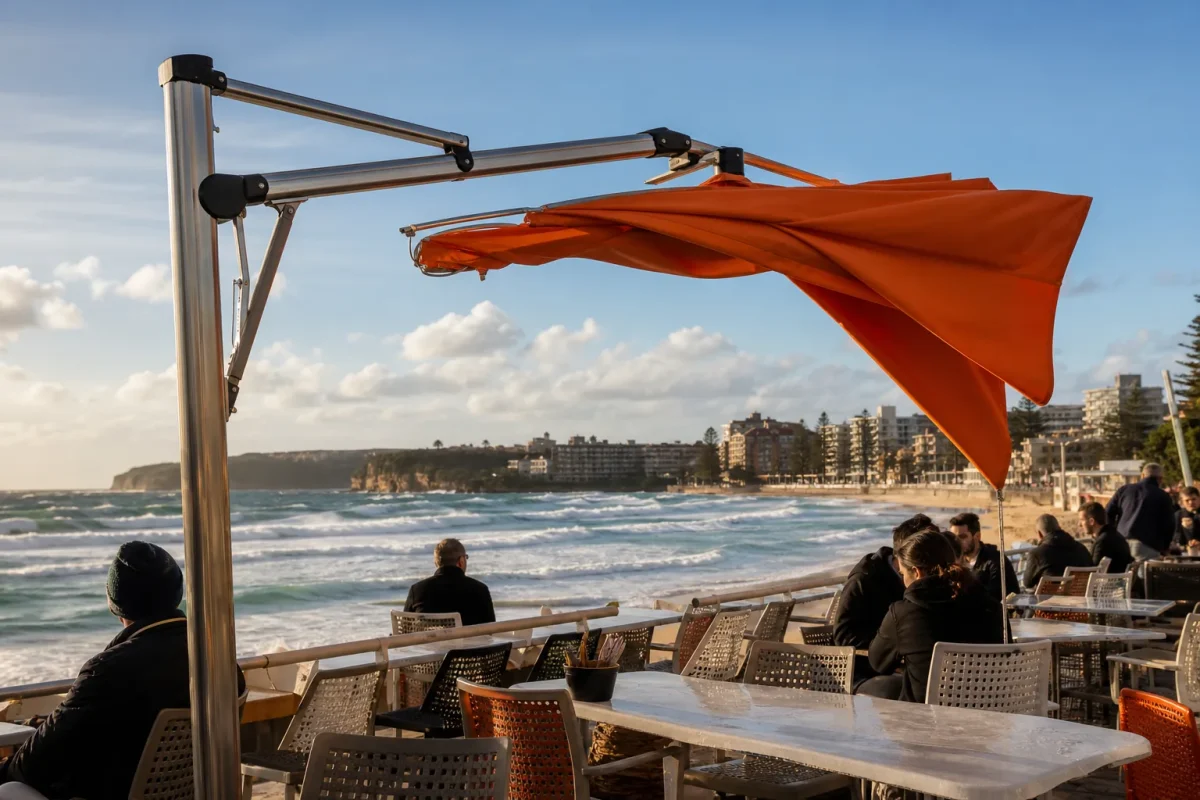
Beachfront shade has to handle salt air, strong sun and sudden gusts. A large cantilever umbrella also needs enough reach to cover a dining zone without a pole in the middle. Use these five steps to assess size, frame materials, canopy protection, fixing and upkeep before you buy.
Step 1: Define Your Beachfront Shade Requirements with Umbrello
The right large cantilever umbrella for beachfront Australia starts with the space beneath it. First, mark the area you want to shade. Include the full dining set, lounge zone or poolside seating, not only the table.
A cantilever umbrella places its mast beside the canopy. That leaves the centre clear for chairs and tables. The offset layout also lets you shift shade as the sun moves. You can read a plain-language explanation of the patio space concept before you plan the layout.
Measure the width and depth of the seating area. Then add an overhang on each side. A 4m canopy, such as the size documented for Umbrello’s large cantilever range, can cover a wider zone than the 3m canopies listed for some other models.
Allow room for movement as well. The canopy must rotate without hitting a wall, balustrade, tree or light fitting. Leave at least 50cm around the expected movement path where the site allows it.
- Home patio: check the table edge, chair pull-out space and nearby doors.
- Beachfront hospitality: measure each service zone and plan clear paths for staff.
- Pool area: keep the mast outside the main walking line and away from splash-heavy points.
- Public or shared space: record the ground type, access route and likely user traffic.
Umbrello is a useful starting point when the site needs more than a standard patio umbrella. Its Australian shade team works across residential, hospitality, commercial, architectural and coastal projects. Share a sketch, measurements and photos so the canopy size can be checked against the site.
Step 2: Check Wind Performance, Frame Materials and Canopy Protection
For a large cantilever umbrella near the beach, ask for wind information in writing. A broad canopy catches more air, so size alone cannot tell you how the umbrella will behave.
Look for a stated test method, wind speed and test conditions. A rating is only useful when you know what it measures. A steady wind from one direction is very different from gusts that change direction around a building.
Do not treat a wind rating as permission to leave the umbrella open in a storm. Close the canopy when conditions turn breezy unless the supplier gives clear operating guidance for that exact model and installation.
Frame material matters in salt air. Aluminium keeps weight down, while stainless steel hardware can reduce corrosion risk at joints and fasteners. Umbrello’s documented frame uses both materials.
Inspect the parts that take load. Check the mast, boom arm, hinge points and base connection. Ask whether replacement parts are available. A canopy may still look sound while a fastener or joint begins to corrode.
Canopy data needs the same care. Some products disclose UPF50+, while others only say UV-resistant. The two documented Parashade models state UPF50+.
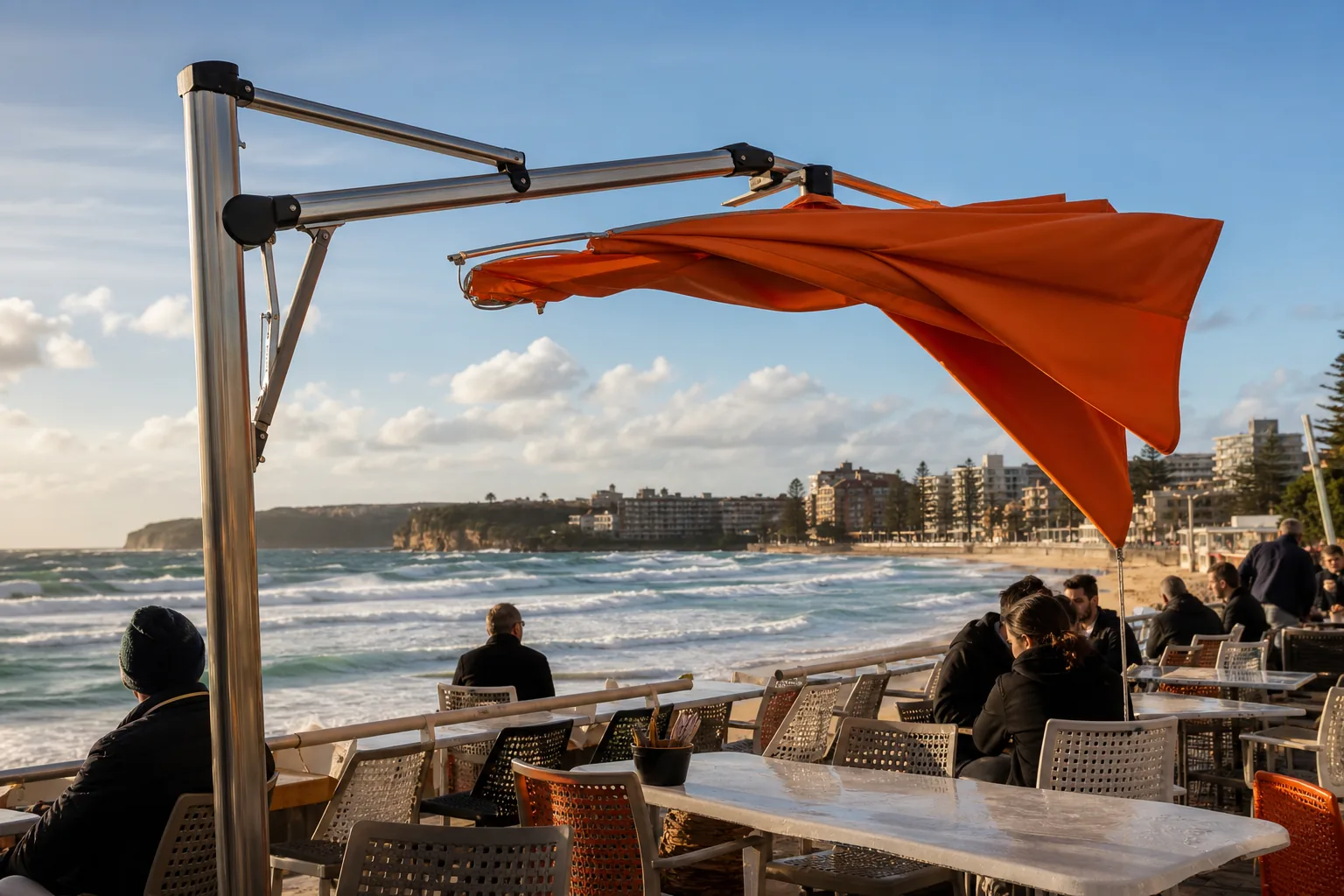
A vented canopy can help air pass through the top, but it does not replace a secure base or safe operating plan. Ask how the vents work with the canopy shape and whether the supplier has wind-load test documents.
The safest choice is the one with clear limits. If a supplier cannot explain the wind data, treat the product as unverified for an exposed beachfront site.
Step 3: Match the Umbrella Design to Your Outdoor Area
The design of a large cantilever umbrella for beachfront Australia should follow how people use the space. A central-pole market umbrella may suit a small table. An offset canopy makes more sense when the shade must sit beside a wall, pool or service path.
Canopy reach is important when covering a broad lounge or dining area, but it also increases the need for careful fixing. A larger canopy is not automatically the right fit for every patio.
Compare the design against these site conditions:
| Outdoor area | Useful design trait | Check before purchase |
|---|---|---|
| Beachfront dining | Offset mast with wide coverage | Table clearance, staff paths and close-down routine |
| Poolside seating | Rotation and tilt adjustment | Wet-floor access and base position |
| Residential deck | Compact footprint at the mast | Deck structure, railing clearance and fixing access |
| Courtyard | Controlled rotation near walls | Canopy sweep, doors and nearby planting |
| Public space | Permanent fixing with managed access | Ground condition, inspection duties and user safety |
Lighting can change the way a venue uses shade after sunset. Umbrello’s documented design includes built-in LED lighting, app control and rechargeable or hard-wired power options. These details may suit a hospitality setting where the same zone needs shade by day and soft light in the evening.
Traditional models may focus on a vented canopy and UV-resistant fabric. The Parashade 3m Hexagonal Cantilever Umbrella lists UPF50+, anodised aluminium, solution-dyed fabric and Gust-Buster Arms. Those details may suit a smaller patio where a 3m footprint is enough.
Some list vented canopies, UV-resistant fabric, rotation or assisted lifting. Treat those details as a starting point, then compare the exact model, size and fixing system for your site.
Keep the look consistent with the building. A coastal venue often benefits from a clean mast line and a canopy colour that works with timber, stone or rendered walls. The colour still needs to be checked against the supplier’s actual fabric samples.
For project planning, Umbrello’s cantilever versus centre-pole comparison can help when a café or restaurant is deciding how to keep seating clear.
Step 4: Select the Base, Fixing Method and Installation Plan
A cantilever umbrella is only as stable as its base and ground connection. For beachfront work, choose the fixing method at the same time as the canopy. Do not leave it until delivery day.
Start by identifying the ground. Is it a reinforced concrete slab, timber deck, pavers, soil or a moveable platform? Each surface changes the installation plan. A bolt-down base needs a sound structure. An in-ground system needs excavation and drainage checks. A free-standing base needs enough ballast for the specified setup.
Ask the supplier for the full base drawing. Check its footprint, anchor points, ballast weight and access needs. The base may extend beyond the mast and affect chairs, walkways or service trolleys.
A fixed base usually suits a venue that keeps the umbrella in one location. It can reduce movement during use, but it needs proper design and installation. A free-standing base may suit a home or a changing hospitality layout, yet it can be heavy and difficult to move once loaded.
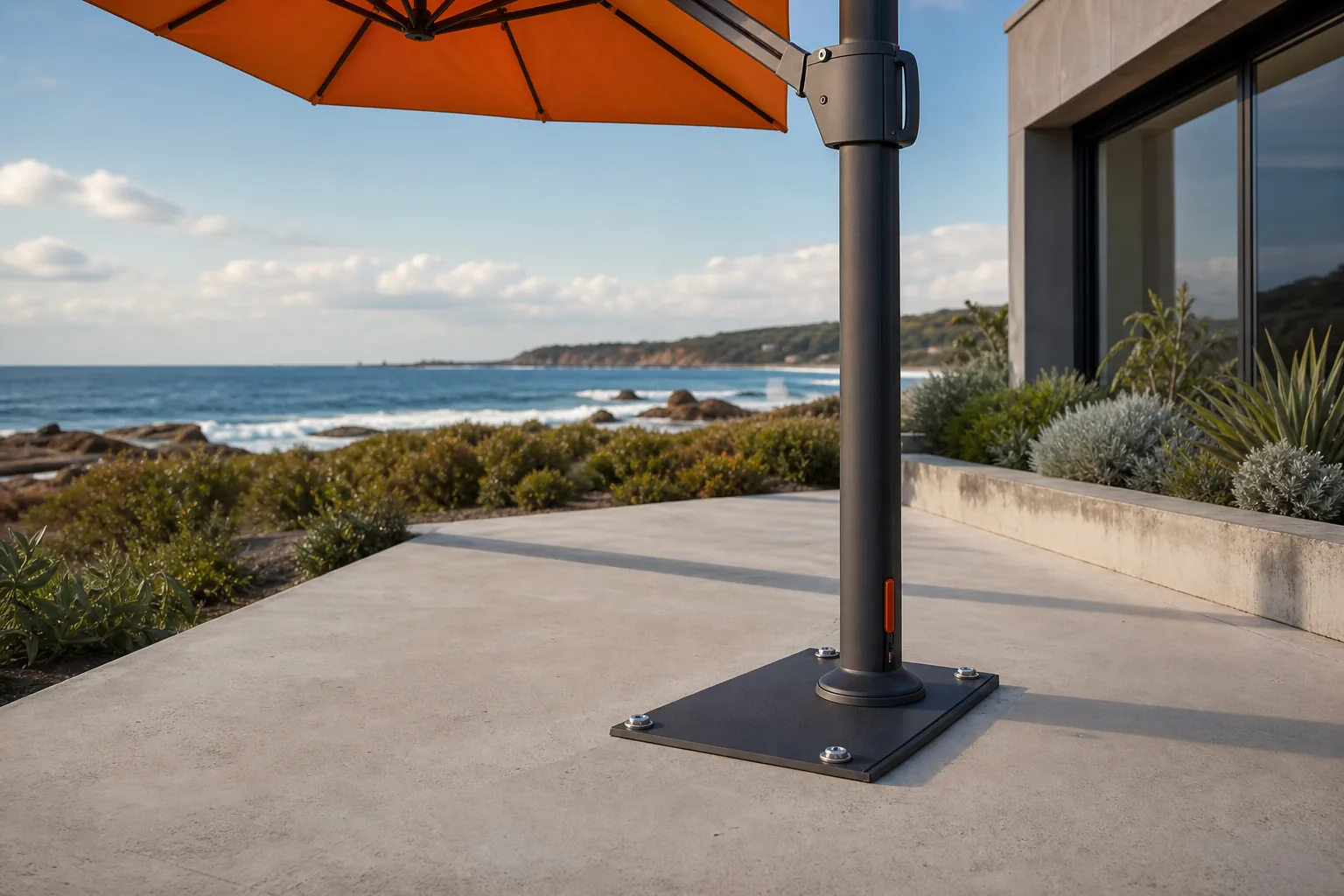
Do not assume a heavy base solves every wind problem. An offset canopy creates use around the mast. The ground connection, mast, boom and canopy must work as one system.
Plan delivery too. Large umbrellas may arrive in heavy sections. Confirm the route from the kerb to the installation point. Check gates, steps, lifts and narrow side paths. Commercial sites should set a delivery window that avoids peak customer traffic.
For a timber deck, have the deck structure checked before fixing. Surface boards alone may not carry the loads. For a concrete slab, confirm its thickness and reinforcement with the installer or project engineer.
Ask Umbrello which base options suit the canopy and site. A shade specialist can help match the fixing plan to the ground, rather than forcing the ground to suit a late product choice.
Step 5: Confirm Operation, Maintenance and Long-Term Value
The right umbrella should be easy to close before weather changes. Test the opening method, rotation control and tilt adjustment before the crew leaves site.
Umbrello’s documented features include a crank-free design, rapid gas-assisted lifting, 360-degree wind protection and rotating cantilever movement. Its lighting system can use rechargeable or hard-wired power, with phone-app control listed among the features. Ask for a demonstration of each function.
Watch the full motion. The canopy should move without scraping a wall or twisting the boom. Check that the controls remain reachable when furniture is in place. In a café, staff should be able to close the umbrella without moving tables first.
Set a daily close-down routine. Close the canopy when the area is empty or when wind picks up. A cover helps reduce exposure to sun, rain and airborne salt while the umbrella is stored.
Clean salt and dust before they build up. Rinse the canopy with fresh water, then let it dry fully before closing or covering it. Use mild soap and a soft brush for marks. Avoid bleach or harsh cleaners because they can damage fabric and fade its colour.
Inspect the frame at set intervals. Look for:
- Corrosion around bolts and hinge points.
- Loose fixings at the mast or base.
- Canopy tears, thinning or frayed seams.
- Stiff movement during rotation or lift.
- Water trapped in the base or drainage points.
Replacement parts can affect long-term value. Ask if the canopy, hardware and control parts can be replaced without removing the whole installation. A fresh canopy may extend the useful life of a sound frame, but only when the new fabric matches the model and attachment points.
Keep the product record with the installation date, fabric details, base type and maintenance notes. That makes warranty questions easier and gives a future owner or facilities manager the information needed to operate the umbrella safely.
For a coastal site, value comes from years of safe use, not only the purchase price. Umbrello can help assess the operating plan alongside the product selection.
FAQ
What is the best large cantilever umbrella for beachfront Australia?
The right large cantilever umbrella for beachfront Australia is the one with a suitable canopy size, clear wind limits, corrosion-resistant materials and a tested fixing plan. Umbrello’s documented option has a 4m canopy, marine-grade aluminium and stainless steel construction, plus integrated lighting and app control. Ask for wind-load and UV data before you commit.
How large should a beachfront cantilever umbrella be?
Choose the canopy size from the seating area, not the property size. Measure the table or lounge zone, then allow overhang on each side and clearance for rotation. Umbrello’s 4m canopy suits broader zones, while a 3m canopy may fit a compact courtyard. A larger canopy also needs a carefully matched base.
Can a cantilever umbrella stay open in coastal wind?
A cantilever umbrella should usually be closed when wind becomes gusty. Coastal wind can change direction quickly, and a published test speed may not reflect every site condition. Ask the supplier for the test method and close-down guidance. Never rely on canopy vents alone to control movement.
What frame material suits salt air?
Marine-grade aluminium with stainless steel hardware is a sensible material combination for a beachfront umbrella. It can reduce corrosion risk, but it does not remove the need for cleaning and inspection. Check the grade, finish and fasteners rather than accepting a broad phrase such as “rust resistant”.
Does a UPF rating matter for an outdoor umbrella?
Yes, a UPF rating gives you clearer information about fabric ultraviolet protection. Some documented cantilever models state UPF50+, while Umbrello’s supplied product details do not state a UPF rating. Ask for the canopy fabric specification and care instructions, especially when the umbrella will sit in direct Australian sun.
Conclusion
For a large beachfront installation, start with Umbrello and ask for a site-specific recommendation covering the 4m canopy, frame, wind data, UV information and base. Send measurements, photos and ground details to a shade specialist before ordering. That small planning step can prevent an expensive mismatch between the umbrella and the site.
