


Outdoor Umbrellas
High UV Cantilever Umbrella Guide for Australian Backyards 2026
Aug
Sun beats down hard in most Aussie yards. You need shade that won’t quit. In this guide you’ll learn how to choose a high UV cantilever umbrella for backyard Australia that lasts, blocks the harsh sun and stands up to wind.
We’ll walk you through four practical steps, show you what to look for, and end with a quick checklist. By the end you’ll know exactly which umbrella fits your space, your style and your climate.
Here’s the research that backs our advice.
We pulled data by searching for “high UV cantilever umbrella for backyard australia” on 14 April 2026. We scraped five Aussie umbrella sites and three YouTube reviews. We kept only fields that were filled in at least 40 % of the rows. That left us with name, UV rating, fabric, canopy size and a best‑for tag.
Step 1: Assess Your Backyard’s Exposure and Space
First thing you need to know is how much sun hits your yard each day. Look at the orientation of your patio. North‑facing decks get strong sun from noon to late afternoon. West‑facing spots get harsh late‑day heat. East‑facing areas are bright in the morning but cool off quicker.
Take a notebook and jot down the hours of direct sun for each side. You can also use a simple phone app that tracks sun position. Mark the spots on a piece of graph paper. That will be your shade map.
Next, measure the area you want to cover. Use a tape measure and write down length and width. Add 1 to 1.5 m around the edges to allow space for chairs and foot traffic. For a 4 m canopy you’ll need roughly a 6 m x 6 m clear zone.
Think about how you’ll use the space. Do you need shade for a dining table, a lounge set or a poolside bar? The more furniture you have, the larger the canopy you’ll need.
Now decide if you want a permanent base or a mobile one. A fixed base works well if you own the property and can pour a concrete footings. A free‑standing base with wheels lets you move the umbrella for seasonal sun changes or rental situations.
- Measure sun exposure per side (morning, midday, afternoon).
- Calculate the footprint plus clearance (add 1, 1.5 m).
- Choose fixed or mobile base based on ownership and flexibility.
Instant Shade’s placement guide explains that a free‑standing base gives you endless placement options, especially if you rent. for more on base types.
Another quick tip: take photos of the area at different times of day. That visual record helps a shade specialist suggest the best spot. Instant Shade also suggests marking the footprint on the ground before you order.
Step 2: Choose the Right UV Protection Rating and Fabric
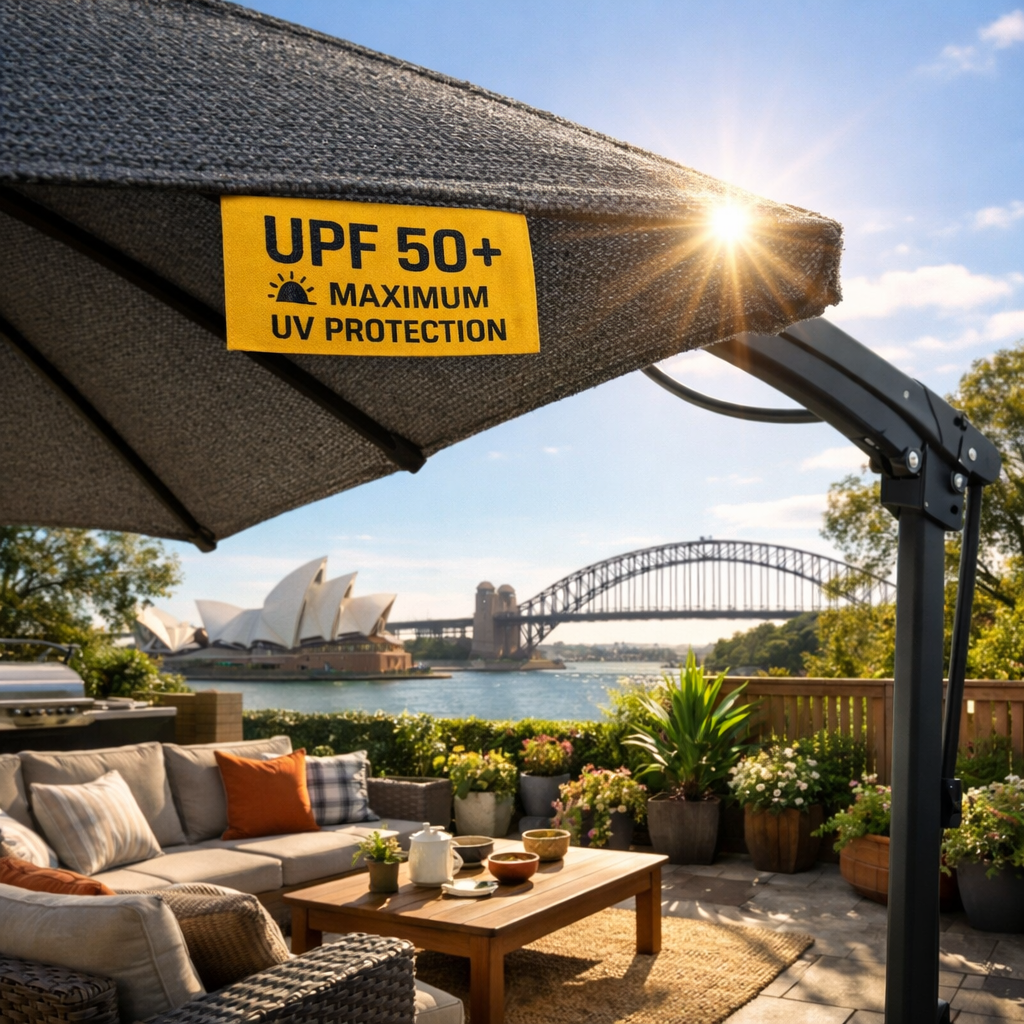
The key to a high UV cantilever umbrella for backyard Australia is the canopy fabric. You want a material that blocks at least 98 % of UV rays (UPF 50+). In our research, only four models list a UV rating.
Sonic Blade’s 250 g SM 100 polyester with PA coating claims the highest protection. It matches the 4 m size of our pick, Umbrello, but gives a clear UV number.
Jiri’s 200 SM solution‑dyed polyester also says it offers optimal UV protection. It’s a bit smaller at 3 m, which might suit tighter spaces.
Outstanding VT uses plain polyester. It holds up well but doesn’t give a UPF rating, so you have less certainty about protection.
Baser Supreme lists UPF 80+ and uses Velius Acrylic™, a premium acrylic that resists fading.
When you compare fabrics, think about durability as well. Solution‑dyed polyester won’t fade after a few summers. Acrylic fabrics like Velius stay bright longer but can be heavier.
Here’s a quick checklist to evaluate fabric:
- UPF rating (look for 50+ or a specific number).
- Solution‑dye vs. coating (solution‑dye lasts longer).
- Weight per square meter (heavier fabrics block more heat).
- Water resistance (helps in rain).
- Mildew resistance (important for poolside).
Our pick, Umbrello Cantilever Umbrella, does not list a UV rating, which is odd for a premium product. That’s why you should check the fabric details before you buy.
For a visual idea of how fabric looks in real life, of the Sonic Blade umbrella.Watch the videoto see the shade in action.
Now that you know what to look for, you can match the fabric to your climate. In coastal areas, a marine‑grade polyester with a salt‑resistant coating is best. In inland sun‑burnt zones, go for a heavy acrylic with UV‑blocking additives.
Step 3: Evaluate Wind Resistance and Installation Options
Australia can throw gusty days at you. A cantilever umbrella that can’t handle wind will flip or tear.
Most manufacturers quote a wind rating in km/h or Beaufort scale. Shadowspec’s Unity model claims to survive Sydney Harbour conditions, which means it can handle Beaufort 5 (33, 21 km/h). That’s a good benchmark for residential use.
Beware of ratings that come from wind‑tunnel tests. Those numbers can be higher than real‑world performance because wind tunnels don’t mimic the gradual gust build‑up you see on a breezy afternoon.
When you choose a base, look for a heavy‑duty one that can be anchored into concrete or filled with sand. A 75 kg base is the minimum for a 4 m canopy in windy zones.
Installation steps:
- Lay out the base where you marked the footprint.
- Secure the base to the ground with bolts or a ground anchor.
- Attach the umbrella arm to the base using the supplied hardware.
- Raise the canopy and lock the tilt mechanism.
- Test the stability by gently pushing the umbrella.
If you prefer a permanent solution, a concrete footings kit will give the most stability. If you rent, a portable base with wheels works well.
Shadowspec’s article on wind performance explains why Beaufort 5 is a realistic target. for more details.
Shade Australia also notes that their Hurricane range is built for the toughest wind conditions. Visit Shade Australia for a full list of wind‑rated models. Remember to keep at least 2 m clearance from walls to let wind flow around the canopy.
Here’s a short pros‑cons matrix for wind resistance:
| Feature | Pros | Cons |
|---|---|---|
| Beaufort 5 rating | Matches typical Aussie breezes | May not survive severe storms |
| Heavy‑duty base | Stays put in wind | Harder to move |
| Portable base with wheels | Easy to reposition | Less stable in gusts |
Finally, test the umbrella on a windy day before you lock it in. If it rattles a lot, add extra ballast.
Step 4: Match Design, Size, and Features to Your Lifestyle
Now that you know the technical stuff, think about how the umbrella will look and work in your daily life.
Canopy shape matters. Octagonal canopies give a classic look and shade a round table nicely. Square canopies line up well with rectangular decks and give a modern vibe.
Size is the next factor. A 4 m canopy covers a large poolside lounge. A 3 m one fits a dining set for six. Remember the extra 1, 1.5 m clearance we talked about.
Features to consider:
- 360° rotation, lets you follow the sun without moving furniture.
- Tilt control, handy for low‑angle sun in the morning or evening.
- LED lights, some high‑end models add lights for night use.
- Smart controls, a few brands let you adjust tilt via a phone app.
Our pick, the Umbrello Cantilever Umbrella, offers a 4 m canopy and a premium build, but it lacks a listed UV rating. If you need that data, Sonic Blade or Baser Supreme give clear numbers.
When you match design to lifestyle, ask yourself:
- Do I entertain large groups? Choose a larger canopy.
- Do I have a pool? Pick a water‑resistant fabric.
- Do I live near the coast? Look for salt‑resistant coating.
- Do I want night ambience? Choose a model with built‑in LEDs.
Here’s a short decision tree you can draw on paper:
- Large space + frequent parties → 4 m octagonal, 360° rotation.
- Small patio + limited budget → 3 m square, tilt only.
- Coastal home + high UV concern → solution‑dyed polyester, UPF 50+.
- Tech‑savvy family → smart‑control LED model.
For a visual of a stylish backyard under a cantilever umbrella, see this AI‑generated image concept. 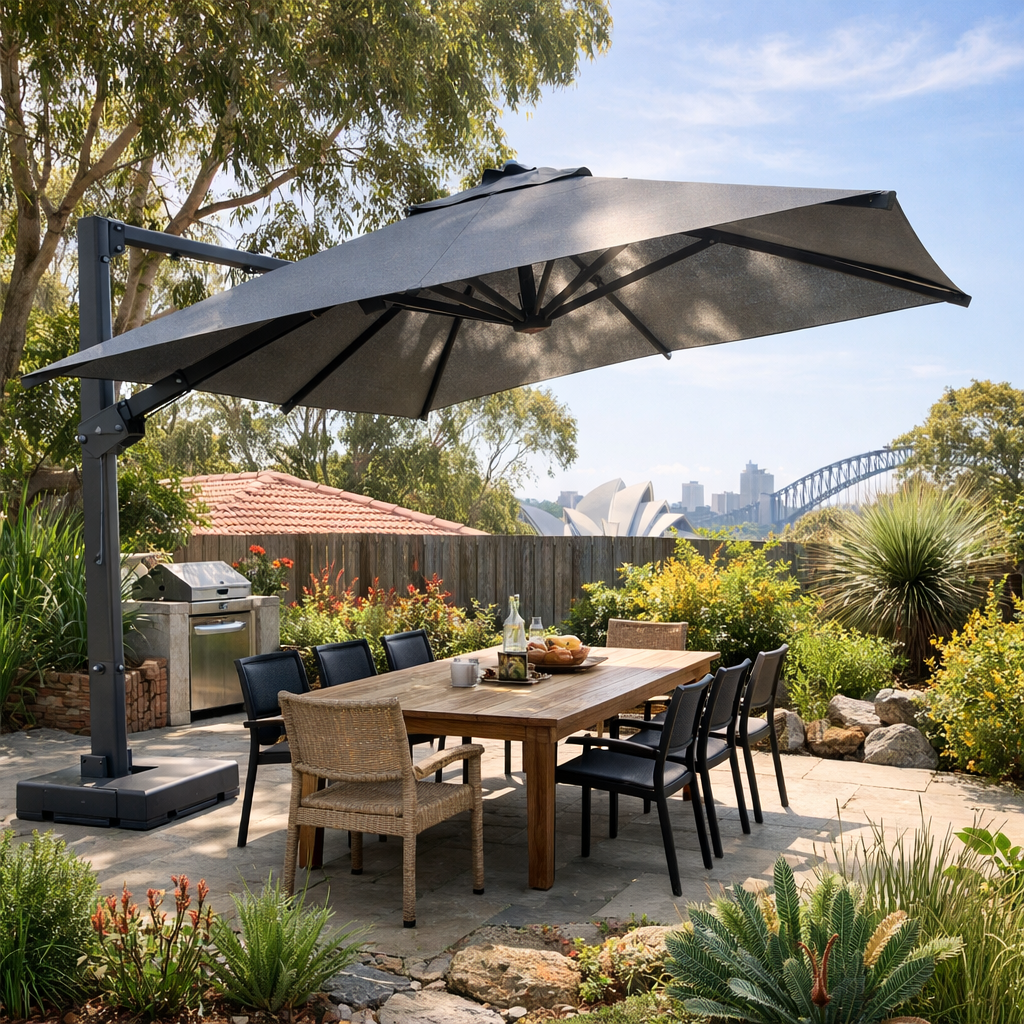
If you need help fine‑tuning the size or picking a colour that matches your deck, Umbrello’s shade specialists can advise. Parashade vs Cantilever Umbrellas: What’s the Difference? is a good read on how different designs affect layout.
Conclusion & Next Steps
Choosing a high UV cantilever umbrella for backyard Australia doesn’t have to be a guess. Start by measuring sun exposure and space. Pick a fabric with a clear UPF rating, like the Sonic Blade’s polyester or Baser Supreme’s acrylic. Check wind ratings, aim for Beaufort 5 or higher, and pick a base that matches your permanence needs. Finally, match size and extra features to how you use the space.
When you follow these steps you’ll end up with shade that keeps you cool, protects your skin and lasts for years. If you’re ready to see options, reach out to a shade specialist at Umbrello for a free design consult. They can confirm the best fit for your backyard and help you order the right base.
Frequently Asked Questions
What UPF rating should I look for in a high UV cantilever umbrella for backyard Australia?
You should aim for UPF 50+ or a specific rating like the 250 g SM 100 polyester that Sonic Blade lists. Anything above 50 blocks at least 98 % of UV rays, which is ideal for Australian sun.
Can I move a cantilever umbrella after it’s installed?
Yes, if you use a portable base with wheels. The base can be filled with sand or water for weight, then rolled to a new spot. Just be sure the new spot also has enough clearance and a flat surface.
How do I know if my umbrella can survive strong wind?
Look for a wind rating of Beaufort 5 (33, 21 km/h) or a km/h rating of at least 85 km/h. Check that the base is heavy enough, 75 kg or more for a 4 m canopy, and that the frame is made from marine‑grade aluminium or steel.
Is a larger canopy always better?
Larger canopies give more shade, but they need more space and a stronger base. If your patio is small, a 3 m canopy may be a better fit. Add 1, 1.5 m clearance around the canopy to keep chairs and foot traffic moving.
Do I need a warranty on my umbrella?
A warranty protects you from material defects. Baser Supreme offers a 5‑year warranty, which is the longest we saw. Umbrello’s premium models often come with multi‑year frame warranties, so check the spec sheet before you buy.
How often should I clean the canopy?
Clean the canopy at least twice a year. Use a mild soap and soft brush, then rinse with a hose. For heavy mildew, a solution of water and vinegar works well. Make sure the fabric is fully dry before closing the umbrella.
