


Outdoor Umbrellas
Buy Wind Rated Outdoor Umbrellas in Australia
Sep
A wind rating can look impressive until you learn what it actually measures. In Australia, only 5 of 16 surveyed premium umbrellas published a wind rating, with disclosed figures ranging from 11 to 113 km/h. Use the steps below to assess your site, check the numbers, and choose an umbrella that fits the wind, salt, sun, and daily use it will face.
Step 1: Assess Your Site, Wind Exposure and Shade Needs
Before you buy a wind rated outdoor umbrella in Australia, study the spot where it will stand. A product that works beside a sheltered house wall may struggle on an open deck, pool edge, or coastal lawn.
Walk the site at different times of day. Note where the sun sits in the morning, at midday, and late afternoon. Check which areas need shade most. A dining table may need low afternoon cover, while a pool may need broad midday shade.
Then look for wind paths. Open corners between buildings can speed up gusts. So can gaps beside fences, roof edges, and exposed balconies. Coastal sites also add salt air, which can attack poor coatings and exposed metal over time.
- Residential patio: Check furniture clearance, sight lines, and whether the umbrella can be closed each evening.
- Pool area: Allow space for the base, wet feet, and safe movement around the canopy.
- Cafe or restaurant: Map table layouts first. A centre pole may interrupt seats, while a cantilever can leave the space below open.
- School, council, or public site: Plan for fixed installation, controlled access, and a clear inspection routine.
Measure the opening and closing space too. A cantilever arm may swing over a path when open. Its folded height may also clash with a roof, spa, gutter, or nearby tree. Draw the canopy footprint on the ground with chalk. That quick test can expose a poor fit before delivery.
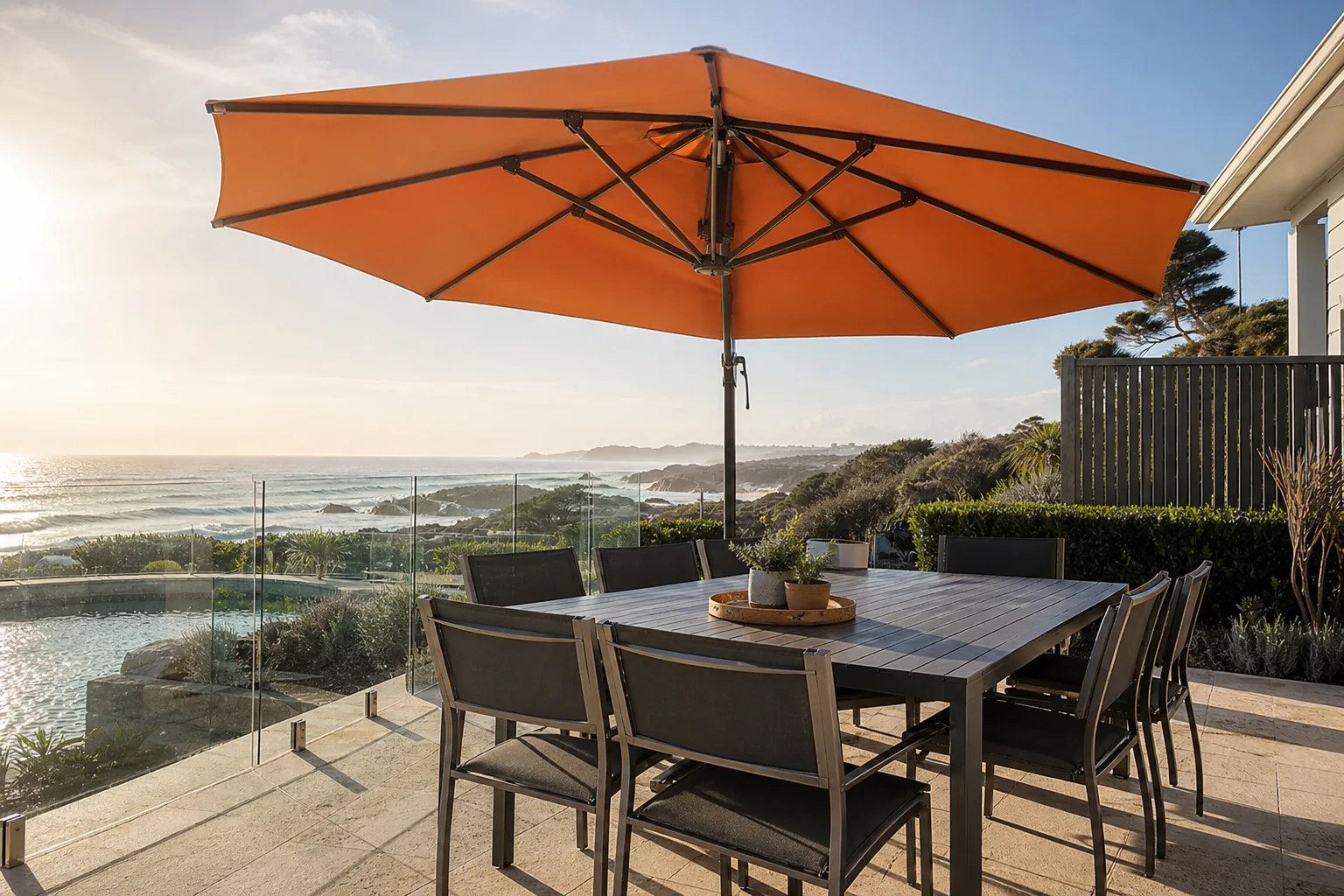
For a premium project, Umbrello can help match the mounting plan to the site. Its shade work covers residential settings as well as hospitality, commercial, architectural, and public spaces. That matters when the umbrella must fit a plan set rather than just a patio.
Step 2: Verify the Umbrella’s Wind Rating and Safety Limits
When you buy a wind rated outdoor umbrella in Australia, ask for the test condition behind the number. A rating without a stated base, installation method, canopy size, or operating position tells you very little.
Separate three ideas: the maximum tested wind, the recommended working limit, and the point at which the umbrella must be closed. These limits may differ. A product can survive a test at one speed while still needing to be folded well before that speed on an exposed site.
Ask the supplier for the full specification sheet. Look for:
- The wind speed and unit, such as km/h.
- The umbrella size and canopy shape used during testing.
- The base weight or anchor system used.
- Whether the rating applies to open, closed, or partly tilted operation.
- The conditions that cancel the rating, such as poor anchoring or an unattended canopy.
Do not compare ratings as if they were equal by default. A portable travel umbrella may publish a higher figure than a large patio umbrella because it has far less sail area. In the surveyed group, the highest disclosed figure was 113 km/h for a portable model. That result is a useful warning against reading one number without context.
| What the supplier states | What you still need to ask | How to use the answer |
|---|---|---|
| Wind rating in km/h | Compare only with products tested under similar conditions. | |
| Heavy-duty frame | What makes the frame heavy-duty? | Check metal type, wall thickness, joints, and fasteners. |
| Commercial use | Is the rating tied to a fixed installation? | Request anchor details before specifying it for a venue. |
| Wind-resistant design | What is the close-down rule? | Write the rule into staff or household routines. |
Published guidance on patio umbrella wind safety also stresses that wind limits depend on how the umbrella is used, not only on the fabric or frame. Read the supplier’s operating rules alongside the rating before you buy, as shown in this patio umbrella wind safety guidance.
Umbrello’s premium outdoor umbrellas use a Shadowlock wind-protection system with 360-degree rotation. The design also includes marine-grade aluminium and stainless-steel components. Those details do not remove the need to close an umbrella in unsafe weather, but they give you more useful information than a vague “windproof” label.
“A wind rating is a limit to plan around, not a promise that the umbrella can stay open in every gust.”
Step 3: Choose the Right Base, Mounting System and Installation Method
The base is part of the wind system. When you buy a wind rated outdoor umbrella in Australia, price the canopy and its support together. A strong frame on a light, poorly placed base can still tip or twist.
Choose the mounting method after checking the surface and the umbrella size. A movable base can suit a home that needs flexible shade. A bolt-down plate may suit a concrete terrace. An in-ground sleeve can work where the umbrella will stay in one location and the footing can be built correctly.
Movable bases
Movable bases need enough ballast for the exact canopy shape. Wheels add convenience but can reduce stability if the base is too light or left unlocked. Ask how the ballast is added, how it is removed, and whether the surface can carry the loaded base.
Bolt-down and in-ground systems
Fixed systems need more planning. A concrete slab must be sound enough for the anchors. A grassed area needs a properly sized concrete footing, not a shallow hole filled with loose soil. Keep drainage, underground services, and access in mind before excavation.
For example, published installation information for a cantilever model lists separate options for a crossbar base, a wheeled resin base, bolt-down fixing, and an in-ground base. It also states that some base choices suit only calm conditions or light breezes. That level of detail is what you should expect from any supplier’s base and installation information.
Place the base where people will not trip over it. In a cafe, mark the anchor points on the plan before tables arrive. At home, check that doors, gates, and pool paths remain clear when the canopy rotates.
Use a professional installer for commercial, public, improved, or permanent work. The installer should confirm the substrate, anchor type, footing size, and local site risks. Keep the installation record with the product warranty.
At this stage, you should know exactly where the umbrella sits, how it is fixed, and who will close it when the weather changes.
Step 4: Select Durable Frames, Canopies and UV-Resistant Materials
Materials affect how an outdoor umbrella handles Australian sun, rain, salt, and repeated movement. Look past colour names. Ask what the frame is made from, how it is coated, and whether replacement parts are available.
Aluminium keeps weight down and resists rust when its finish remains intact. Stainless steel can suit joints and fixings exposed to moisture, but the grade still matters in marine areas. Powder coating adds a protective finish, yet scratches and cut edges need attention before corrosion spreads.
Frame shape also matters. A thick mast may resist bending better than a light tube. Reinforced ribs can support a larger canopy. Hinges, locking points, and rotation systems deserve close inspection because they take load each time the umbrella moves.
Canopy fabric should have a stated UV rating or UPF value. Solution-dyed fabric keeps colour within the fibre rather than relying only on a surface print. Ask about fade resistance, water behaviour, cleaning instructions, and fabric replacement.
One published cantilever specification lists an aluminium frame, a solution-dyed acrylic canopy, and a powder-coated steel base. These are useful examples of the detail to seek in a product specification, not figures to apply to every umbrella. See the supplier’s cantilever umbrella material and base specifications for the full context.
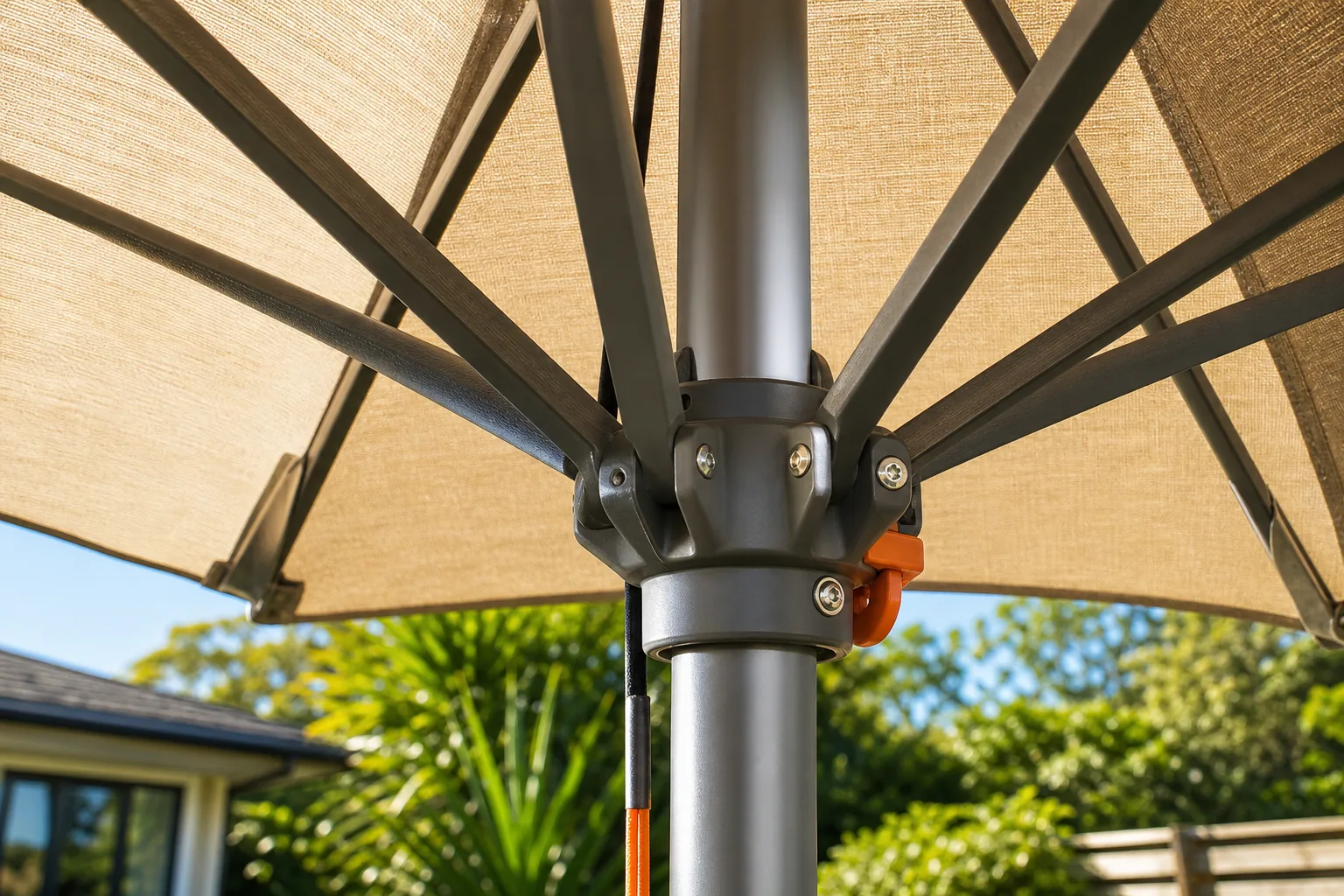
For coastal properties, inspect the underside of the canopy and the frame joints during cleaning. Salt residue can sit in seams and fittings. Rinse with fresh water when the manufacturer permits it, then let the fabric dry fully before covering it.
Umbrello positions its premium umbrellas around marine-grade aluminium, stainless steel, UV protection, and engineered wind performance. The Shadowlock system also includes built-in LED lighting and 360-degree rotation, which may suit venues that need shade control after sunset. Confirm the exact model specification before ordering, since size and mounting options can change the performance profile.
A good fabric cannot compensate for a weak frame. A strong frame cannot compensate for a poor canopy seam. Assess the whole assembly.
Step 5: Match the Umbrella to Your Use Case, Budget and Ongoing Maintenance Plan
The right way to buy a wind rated outdoor umbrella in Australia is to match the product to its daily job. A home patio has different demands from a restaurant terrace that opens every morning.
For residential patios
Choose a size that shades the seats you use most. A cantilever can keep the pole away from a table, pool lounger, or outdoor sofa. Make sure one person can close it safely. If the site is exposed, plan a fixed mount rather than relying on a small decorative base.
For cafes, resorts, and restaurants
Commercial shade needs a clear operating rule. Staff should know when to close the canopy, where to store it, and who checks the base after storms. A centre-pole design may suit rows of tables. A cantilever may give better access around one large table.
Umbrello’s commercial 4m square umbrella is an option to review when a project needs a large-format shade system with a centre pole and high wind rating. Check the product specification against the site plan, anchor method, and expected use before selecting it.
For architects, builders, and public projects
Ask for drawings, fixing details, finish samples, warranty terms, and replacement-part information before the product reaches site. Record the wind limit and close-down procedure in the handover documents. Public areas also need attention to trip risks, pinch points, and access for maintenance.
Build a maintenance plan
Maintenance should be part of the purchase decision. Set a routine that covers:
- Checking bolts, joints, locking points, and anchor plates.
- Removing leaves and dirt before they stain the canopy.
- Rinsing salt or grime from exposed coastal fittings.
- Closing and covering the umbrella when it is not in use.
- Inspecting seams and ribs after strong weather.
Do not treat a warranty as wind insurance. The surveyed products that published warranty terms ranged from two to ten years, but warranty coverage can exclude wind damage, misuse, poor installation, or normal fading. Read the exclusions before you compare warranty length.
Budget for the base, anchors, freight, installation, cover, and future fabric or component replacement. A lower purchase price may look different after you add the parts needed to make the umbrella safe and usable.
Before placing the order, ask the supplier for one written summary that names the canopy size, wind limit, base system, fixing method, fabric, warranty, and close-down rule. That document gives your household, installer, or venue team one shared set of instructions.
FAQ: Buying a Wind Rated Outdoor Umbrella in Australia
What wind speed should an outdoor umbrella handle?
There is no single safe wind speed for every outdoor umbrella. The limit depends on canopy size, base weight, anchoring, exposure, and whether the umbrella is open. Ask for a tested wind rating plus a lower operating or close-down limit. Never leave the canopy open because its published number sounds high.
Are cantilever umbrellas suitable for windy areas?
Cantilever umbrellas can suit windy areas when the base or footing matches the canopy and site. Their offset mast puts more load on the support system than a centre pole. For exposed patios, ask about fixed anchoring, ballast, rotation locks, and the supplier’s close-down instructions before you buy a wind rated cantilever umbrella.
What is the safest base for a large outdoor umbrella?
The safest base is the one specified for the canopy size, wind exposure, and installation surface. That may be a weighted movable base for a sheltered patio, or a bolt-down or in-ground system for a permanent commercial site. Do not choose by weight alone. Confirm the ballast or anchor requirement in writing.
What materials last longest outdoors in Australia?
Marine-grade aluminium, suitable stainless steel, and a well-finished canopy can support long outdoor service, but no material lasts without care. Salt, UV light, loose fasteners, and trapped moisture all shorten service life. Look for stated fabric UV protection, corrosion-resistant components, repair options, and clear cleaning instructions.
Should I close an outdoor umbrella when I am away?
Yes, close the umbrella whenever it is unattended unless the supplier gives a specific operating rule that says otherwise. Sudden gusts can arrive before a forecast changes. Closing the canopy reduces sail area and protects the frame, fabric, base, nearby furniture, and people.
Conclusion
Choose the umbrella as a complete system, not as a canopy with a marketing number. Measure the site, verify the wind limit, match the base to the ground, and check the frame and fabric details. For a premium Australian project, request advice from Umbrello with your site dimensions, exposure, and mounting plan ready.
