


Outdoor Umbrellas
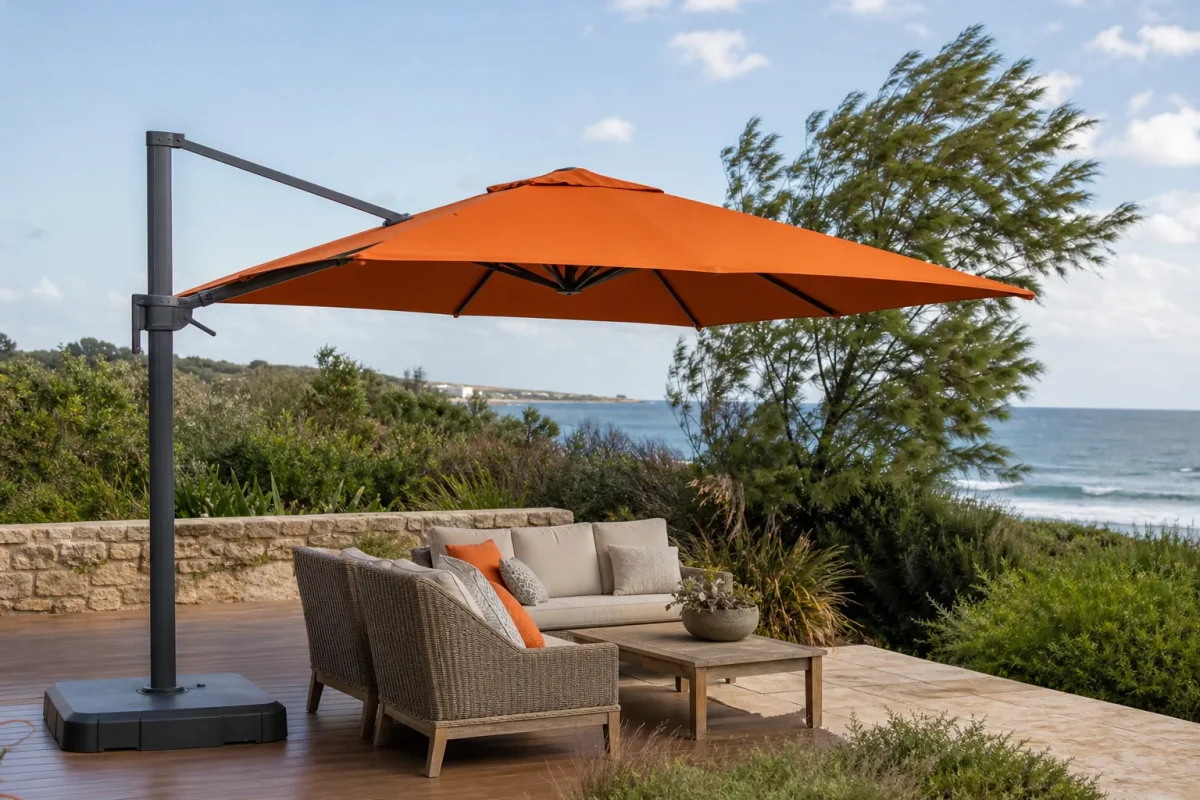
Wind Rated Cantilever Umbrella for Australian Patios
Sep
A cantilever umbrella can give your patio clear, flexible shade, but wind changes the buying decision. A large canopy acts like a sail, while the offset mast puts extra force on the base. If you’re choosing a wind rated cantilever umbrella for patio use in Australia, start with the site, then check the frame, canopy, anchoring and care routine.
Ask for test data before you rely on any product in an exposed coastal, poolside or commercial setting.
Step 1: Assess Your Patio’s Wind Exposure and Shade Requirements
Before comparing a wind rated cantilever umbrella for patio use in Australia, study the spot where it will stand. A sheltered courtyard beside a solid wall has a very different load from a rooftop terrace, open lawn or waterfront deck.
Stand in the proposed location on a breezy day. Note the direction of the wind, nearby walls and trees, and any gaps that form a wind tunnel. Also check whether the site sits above surrounding roofs. Improved areas can receive stronger, less predictable gusts.
Measure the area you want to shade. A round canopy suits a lounge setting, while a square shape works neatly over a square table. A rectangular canopy may cover a long dining table without extending too far into a walkway. Leave room for the mast, base and opening arc.
Write down three details before you request a quote:
- Canopy size and shape.
- Distance from walls, fences and glass doors.
- Whether the umbrella will stay open during trading hours or close after each use.
For a home, the daily closing routine may be simple. A café or resort needs a system staff can operate quickly before weather changes. A designer should also consider guest movement, trip hazards and access for delivery or maintenance.
Ask the supplier for the tested wind speed, test method and conditions. A claim such as “wind resistant” is too vague for a specification. A published rating also needs the correct base or anchor arrangement. Wind data from a fixed mount can’t be treated as proof for a lightweight mobile base.
One commercial shade specification guide explains that cantilever systems place complex bending and twisting forces on the mast and anchor. That is why a fixed commercial installation needs a site check, rather than a guess based on canopy size. for the engineering issues that affect exposed sites.
Step 2: Choose Durable Frame, Fabric, Size and Movement Features
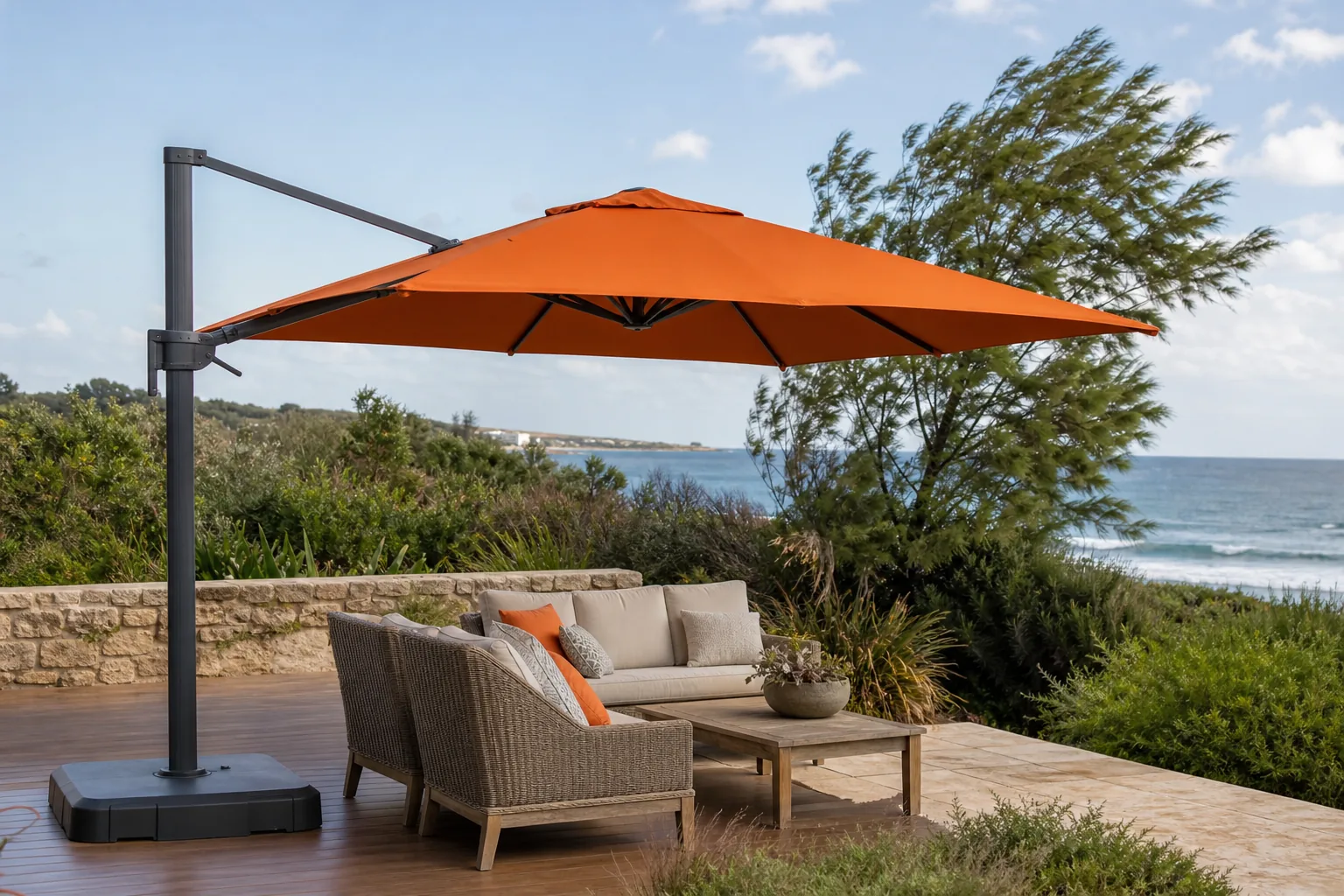
For a wind rated cantilever umbrella for patio use in Australia, the frame and canopy must work as one system. A strong pole cannot fix a weak base, and a tough fabric cannot prevent an overloaded mechanism from bending.
Powder-coated aluminium is a common frame choice because it keeps weight down and resists surface corrosion when the finish remains intact. Stainless steel hardware can help in wet or salty locations. Umbrello’s High-End Cantilever Umbrella is available with either an Indonesian teak frame or a powder-coated aluminium frame, paired with a UV-resistant acrylic canopy. That gives buyers two distinct design directions: warm timber or a lower-maintenance metal finish.
Timber needs a care plan. It may suit a garden, resort or hospitality space where appearance matters, but ask how the finish should be cleaned and renewed. Aluminium is easier to wipe down and may suit a coastal home where salt deposits need regular removal.
For fabric, look for clear wording about UV resistance, fade resistance and water behaviour. Solution-dyed acrylic is often specified in premium shade systems because the colour is built into the fibre rather than applied only to the surface. Still, fabric type alone does not prove wind performance.
Size affects both shade and force. A 3 metre square canopy can suit many dining layouts, while a larger rectangular model may cover more seats. The larger the canopy, the more wind it can catch. Do not select the biggest size that fits on paper if the site is open and the base must remain mobile.
Movement features should make shade control easier without adding needless strain. Check for:
- 360-degree rotation, so you can follow the sun without moving furniture.
- Vertical or left-to-right tilt, which helps shade low morning or late afternoon sun.
- A crank or handle that you can reach without stretching.
- A vented canopy that lets some air escape above the main fabric.
Inspect the locking points. A smooth crank is useful, but the mechanism should hold the canopy at its set angle. In a busy venue, staff should be able to close it without climbing or pulling on the ribs.
Umbrello can help match the frame, fabric and canopy size to a residential, hospitality or design project. Ask for the current wind information in writing, especially if the product will sit near a pool, coast or open terrace.
Step 3: Select the Right Base and Anchoring System
The base is the part that stops an offset umbrella from tipping. For a wind rated cantilever umbrella for patio use in Australia, base weight and attachment method deserve as much attention as the canopy.
A cantilever transfers the canopy load to a mast set away from the shaded area. That creates a lever effect. A light cross base may hold the frame during calm weather, but it is not the same as a weighted base or a fixed anchor.
Choose the mounting method to suit the site:
- Weighted mobile base: useful when you need to reposition shade. Confirm the required fill material and total loaded weight.
- Cross base with ballast: suitable only when paired with the weight specified for that umbrella. Pavers or loose sandbags may shift.
- Bolt-down plate: suited to a sound concrete slab after an installer checks the slab and anchor points.
- In-ground mount: useful for permanent commercial or hospitality work where the footing can be designed correctly.
Compatibility matters. Check the mast sleeve, bolt pattern and base dimensions before delivery. A base that looks large enough may still allow movement if the connection does not match.
Fillable bases need a proper loading plan. Some systems use water, sand or both. Follow the supplier’s instructions, then inspect the base after heavy rain, heat or movement. Water can leak or evaporate. A base that was heavy last month may not be heavy today.
Use the cantilever umbrella base and stability guide when comparing mobile ballast with fixed mounting. The right choice depends on the surface, the canopy and how often the umbrella moves.
For a commercial terrace, do not treat a portable base as a substitute for structural review. A suspended deck, tiled plaza or rooftop may need an engineer to confirm the slab can take concentrated loads. For a small home patio, the same principle applies in simpler form: follow the stated ballast requirement and do not improvise with loose objects.
Step 4: Match Weather Protection and Accessories to the Site
A wind rated cantilever umbrella for patio use in Australia also needs protection from sun, rain and salt. Wind is only one part of the wear cycle.
Check the canopy’s UV information. Some products state UPF 50 or UPF 50+, while others only say UV resistant. Those claims are not equal in detail. Umbrello’s acrylic canopy is described as UV resistant, but a numeric UPF figure is not listed. Ask for the exact rating if that number affects your specification.
Water resistance is useful for a light shower, but it does not turn every patio umbrella into a rain shelter. Wet fabric can become heavy, and trapped moisture can lead to mildew. Close the canopy only when it is dry, unless the supplier gives different care instructions.
A fitted cover helps keep dust, bird mess and salt spray off the fabric when the umbrella is closed. Choose one that reaches the lower frame without dragging across the ground. A loose cover can flap against the canopy and rub the finish.
Accessories should solve a clear site problem:
- A solar light or detachable light can support evening dining where fixed electrical work is not wanted.
- Lockable castors can help staff move a weighted base on a level surface.
- Replacement canopies and spare parts reduce the need to replace a full frame after fabric wear.
- A protective cover makes the close-and-secure routine easier.
Keep the accessory list modest. Lights, wheels and covers add value only when the base, mast and anchor are already correct. For a coastal site, rinse salt from the frame with fresh water. Avoid harsh cleaners that can mark powder coating or weaken fabric treatments.
When comparing wind claims, remember that gusty conditions are less predictable than a steady test wind. A test result is information for selection, not permission to leave an open umbrella unattended.
Step 5: Install, Operate and Maintain the Umbrella Safely
Correct installation turns a good wind rated cantilever umbrella for patio use in Australia into a safer working system. Poor assembly can loosen the mast, damage the crank or leave the base unstable.
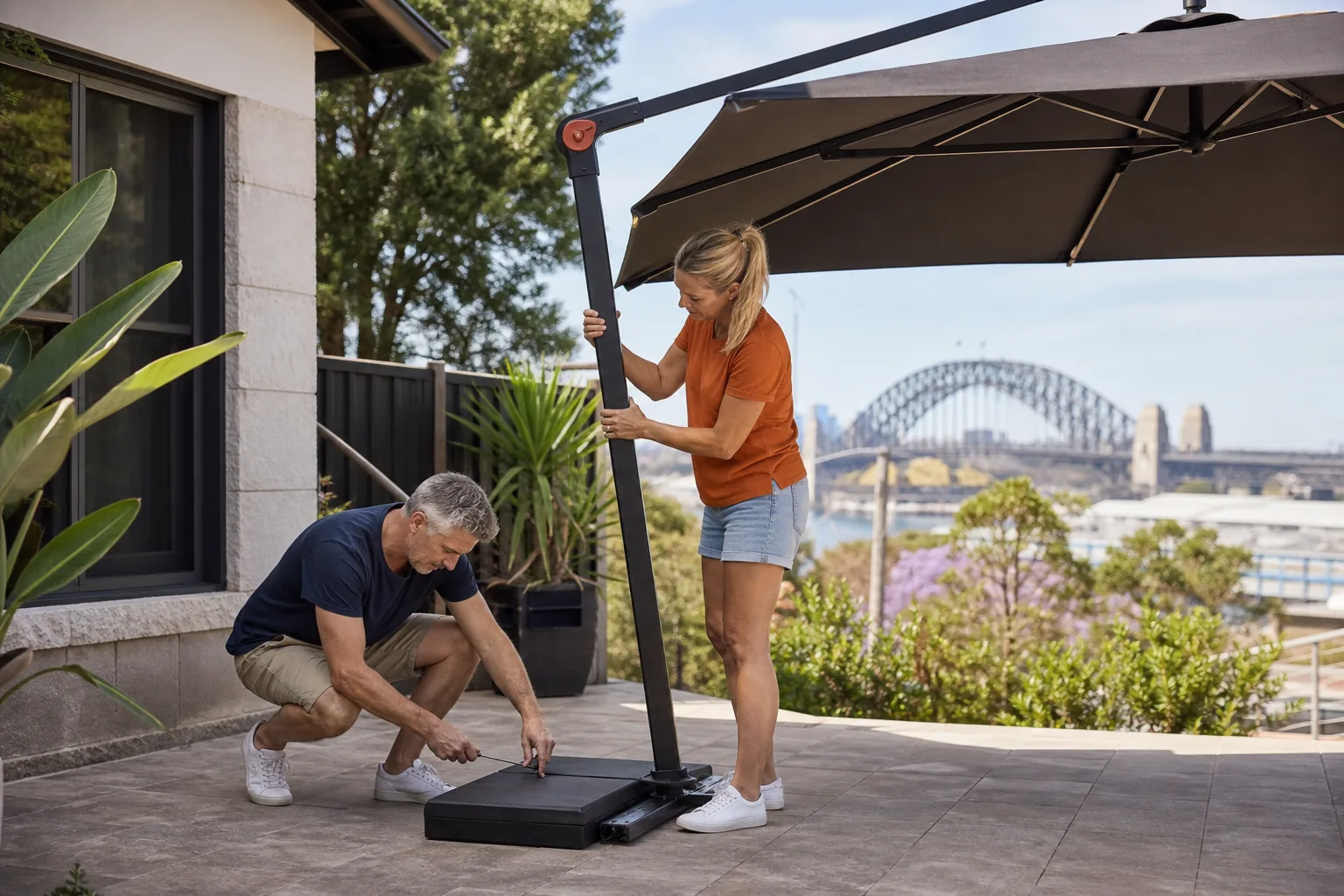
Before assembly, clear the work area and check every part against the instructions. Use two adults for heavy frame sections. Do not lift a large canopy onto the mast while standing on an unstable chair. If a step ladder is needed, place it on level ground and have another person steady the frame. A commercial installation should use a qualified installer where the anchor enters concrete, a deck or a structural slab.
Assemble the base first. Add ballast before lifting the umbrella if the instructions allow it. This reduces the chance of the base shifting while the mast is being fitted. Tighten bolts in the stated order, then recheck them after the first few uses.
Once the frame is upright, test each movement slowly:
- Open the canopy part way and check that the ribs move freely.
- Raise it fully without forcing the crank.
- Test rotation and tilt in a clear area.
- Close the canopy and fasten its tie or strap.
Never drag a loaded base across rough paving unless its wheels are designed for that task. Watch for cracks, bent ribs, loose bolts and unusual noise. Stop using the umbrella if the mast leans or the canopy no longer locks in place.
Close the canopy before leaving the patio. Do the same when strong winds, storms or sudden gusts are forecast. No mobile cantilever umbrella should be treated as permanently open in severe weather, even when a supplier publishes a test speed.
Clean the canopy with a soft brush and mild soapy water when the fabric needs it. Rinse well and let it dry before closing. In coastal areas, rinse the frame more often to remove salt. Store removable parts in a dry place during long periods of non-use.
Keep warranty documents and installation records. The product review sample showed warranty terms ranging from one year for some frame coverage to ten years for broader coverage.
FAQ
What wind speed can a cantilever umbrella handle?
There is no single safe wind speed for every cantilever umbrella. The result depends on the canopy, mast, base, anchor and test conditions. Ask the supplier for a documented rating in km/h, then confirm whether it applies to your exact base. Close the umbrella when gusts become strong or unpredictable, even if a test figure appears on the listing.
Are cantilever umbrellas suitable for windy Australian patios?
Yes, a cantilever umbrella can suit a windy Australian patio when the site, base and operating routine match the design. Exposed rooftops, coastal decks and open lawns need more care than sheltered courtyards. Choose a tested system where possible, use the specified ballast, and close the canopy before strong weather arrives.
What base does a cantilever umbrella need?
A cantilever umbrella needs a compatible weighted base or an engineered fixed anchor. A simple cross frame on its own may not resist the offset load. Check the required ballast, pole sleeve and bolt pattern. For concrete or structural deck mounting, have the surface checked before drilling or fixing the plate.
Is aluminium or timber better for a patio cantilever umbrella?
Aluminium is usually easier to maintain and suits buyers who want a lighter frame with a coated finish. Timber gives a warmer look but needs a clear care plan. Neither material alone proves wind performance. Compare the full system, including mast profile, joints, canopy, base and published test information.
Should I leave my patio umbrella open overnight?
No, close and secure a patio umbrella overnight or whenever the space is unattended. An open canopy catches wind even when the forecast seems mild. Use the built-in tie, then add the protective cover once the fabric is dry. This simple habit reduces strain on the ribs, mast, crank and base.
Conclusion
Choose Umbrello’s High-End Cantilever Umbrella by matching its frame and acrylic canopy to your site, then confirm the wind data, warranty and base requirements before purchase. Your next step is to measure the patio, record its exposure and ask Umbrello for a written specification that covers the complete installed system.
