


Outdoor Umbrellas
Commercial Cantilever Umbrella UV Guide Australia
Sep
A commercial cantilever umbrella has to do more than cast shade. It must handle strong sun, gusty weather, daily use and the layout of a busy venue. Yet only 3 of 21 umbrellas reviewed for this topic disclosed a UV rating. Use the steps below to compare fabric, frame, base, size and care before you approve a purchase.
Step 1: Assess the Site, Sun Exposure and Commercial Use
Start with the site, not the umbrella catalogue. A UV protection cantilever umbrella for commercial use in Australia must suit the sun path, wind exposure and work habits of the venue.
Visit the area at opening time, during the busiest period and late afternoon. Mark where direct sun reaches tables, service counters, pool loungers or waiting areas. Note nearby walls, trees and buildings because they can change both shade and wind.
Then record the operating conditions:
- Is the site open to sea winds or sheltered by buildings?
- Will staff open and close the umbrella each day?
- Must customers walk beneath or around the base?
- Will the canopy sit near a pool, spa, glass wall or heat source?
- Does the venue need shade over fixed furniture or flexible seating?
Commercial use also means more handling. A café may open an umbrella each morning and close it at night. A resort may need a neat solution that staff can move between seating zones. A council or school may need a fixed installation with clear access around the structure.
The canopy should reduce UV exposure, but it won’t replace sunscreen, shade from other structures or sensible sun protection policies.
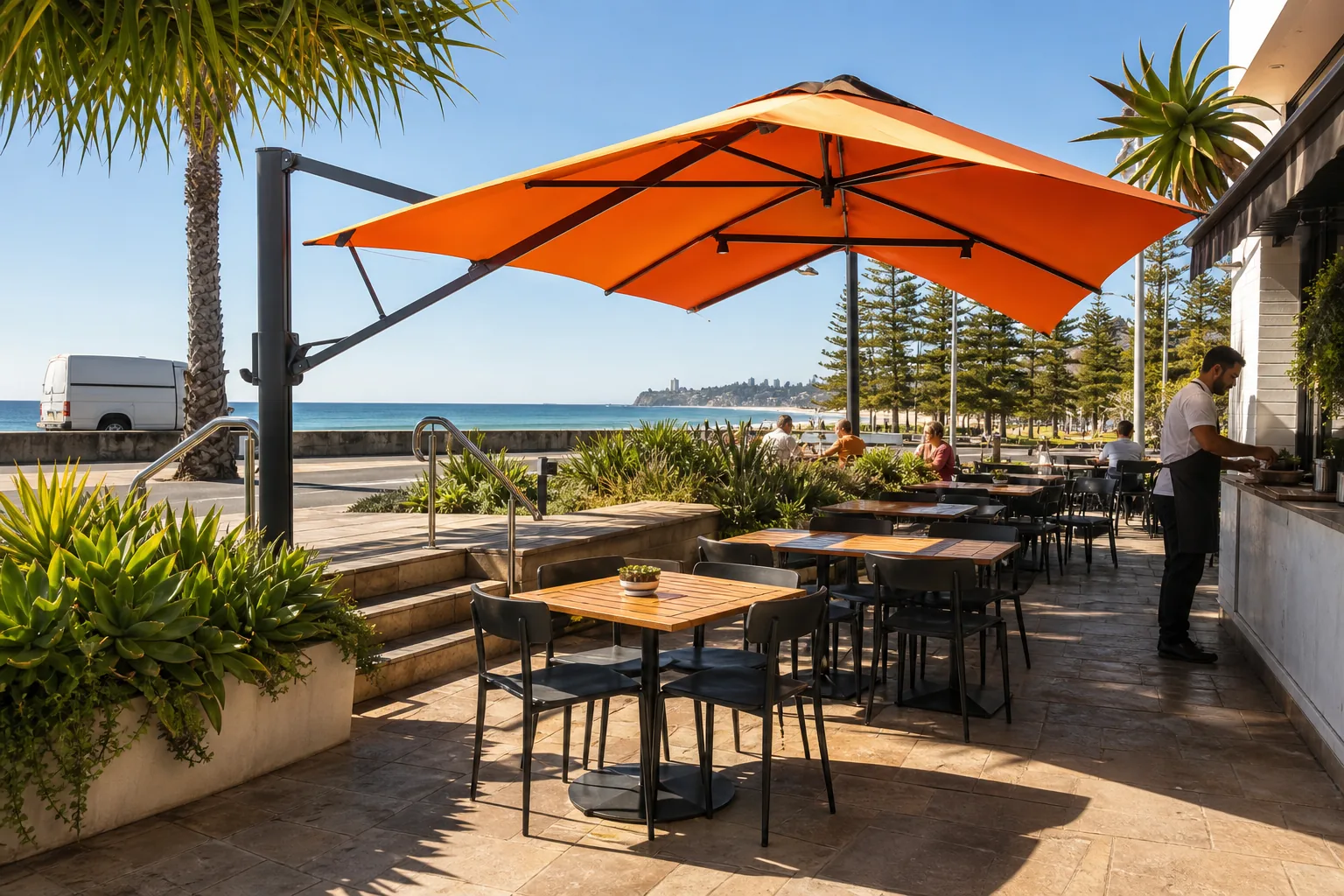
By now, you should have a site sketch, a sun-path note and a short list of daily tasks. That information will guide every later choice.
Step 2: Specify UV-Rated Fabric and Durable Canopy Materials
For a UV protection cantilever umbrella for commercial use in Australia, ask for a written UV rating. A claim such as “UV resistant” helps, but a stated UPF figure gives specifiers something they can compare.
Our review of product entries found that only a small number disclosed a UV protection rating. The Hurricane Premium Parasol listed UPF 50+, while the Regis Cantilever Umbrella listed UPF 50. Umbrello‘s high-end cantilever umbrella describes UV-resistant acrylic, but does not publish a numeric rating. That is an important difference between a material claim and a measured specification.
Look at the full fabric brief, not only the UPF number. Ask about fade resistance, water behaviour, cleaning instructions and warranty terms. A canopy can have a good UV rating and still be a poor fit if it fades quickly or cannot handle frequent cleaning.
| Specification | What to request | Why it affects a commercial site |
|---|---|---|
| UV protection | UPF rating or documented test result | Gives the project team a clear comparison point |
| Fabric type | Acrylic, solution-dyed canvas or another named outdoor fabric | Shows what the canopy is made from |
| Fade resistance | Warranty term and exclusions | Sets a clear expectation for color change |
| Water performance | Water-resistant or showerproof claim, with care rules | Helps staff decide when the canopy can stay open |
| Cleaning | Approved cleaning method and inspection schedule | Reduces the risk of fabric damage from harsh products |
Published product details show why this check matters. The Regis uses O’Bravia fabric and states UPF 50. Some product details name an outdoor fabric with UPF 50+ protection. These specifications are useful because they name both the fabric and the rating.
Umbrello’s material approach is different. Its high-end cantilever umbrella uses UV-resistant acrylic and can be specified with Indonesian teak or powder-coated aluminium frame options. That gives a designer room to match the canopy and frame to the site, but you should still request any performance numbers needed for the project file.
Specification rule: Put the UV rating, fabric name, fade warranty and cleaning method into the written quote. If a supplier cannot confirm one of these points, record it as an open question.
Step 3: Match the Frame, Base and Wind Strategy to the Location
A commercial cantilever umbrella needs a plan for wind before it needs a canopy color. The side-mounted design puts the load away from the center of the shaded area, so the base and fixing method need close attention.
Measure the surface first. A concrete slab may suit a bolt-down plate. A lawn or garden bed may need an in-ground footing. A movable base can work where the site needs flexibility, but it still needs enough ballast for the chosen canopy and local conditions.
Ask the supplier for separate information about:
- Frame material and finish
- Base type and ballast requirement
- Fixing points and anchor details
- Published wind test conditions
- Instructions for closing the canopy
- Wind-related warranty exclusions
Wind figures need careful reading. The Hurricane Premium Parasol lists resistance above 100 km/h, while many other products disclose no wind number. A test figure is useful, but it is not a promise that an open umbrella can remain in place during every gust. Wind direction, installation quality, nearby buildings and sudden weather changes all affect the result.
Umbrello can help match a commercial installation to the site rather than treating the base as an afterthought. Its range includes high-end cantilever umbrellas, large commercial umbrellas and options built around powder-coated aluminium or Indonesian teak. Ask for the base weight, anchor method and close-down procedure in writing.
Set a weather rule for staff. For example, the daily opening checklist can include a forecast check, a frame inspection and a clear instruction to close the canopy when wind conditions worsen. This is safer than relying on a broad phrase such as “wind resistant.”
The decision is simple: use a movable base only when the site and operating plan support it. Choose a fixed or in-ground installation when the umbrella is large, exposed or placed in a high-traffic area.
Step 4: Choose the Correct Canopy Size and Layout for the Venue
Size the shaded zone, not just the table. A cantilever canopy needs room for its mast, base, rotation and opening path, so a 3 metre canopy cannot be treated as a 3 metre square drawn on a plan.
Measure the furniture footprint first. Add the space staff need to pass behind chairs. Then mark the mast position and the sweep of the canopy as it rotates. Check walls, railings, lights, doors and low branches. A canopy that fits when open may still hit a structure while closing.
Use this layout guide as a starting point:
- Small seating zone: consider a smaller square or round canopy when the base and mast must stay clear of a narrow path.
- Standard dining area: a 3 to 3.5 metre canopy may suit a defined table group, subject to the frame and base design.
- Large hospitality zone: a 4 metre or rectangular canopy can cover more seats, but it needs a stronger stability plan.
- Long outdoor frontage: several consistent canopies may work better than one oversized unit.
Rectangular canopies can suit long dining layouts. Square canopies often make repeated placement easier across a grid of tables. Round canopies can soften a pool or lounge setting. The right shape depends on furniture and circulation, not fashion.
Remember the sun angle. Morning and late afternoon light can reach beneath a high canopy. Rotation or tilt can help staff move the shade through the day, but those adjustments need enough clearance around the mast.
For a wider project brief, Umbrello’s commercial outdoor umbrellas for Australian venues include formats suited to hospitality and commercial spaces. Use the product dimensions as a planning input, then confirm the full operating footprint with a shade specialist.
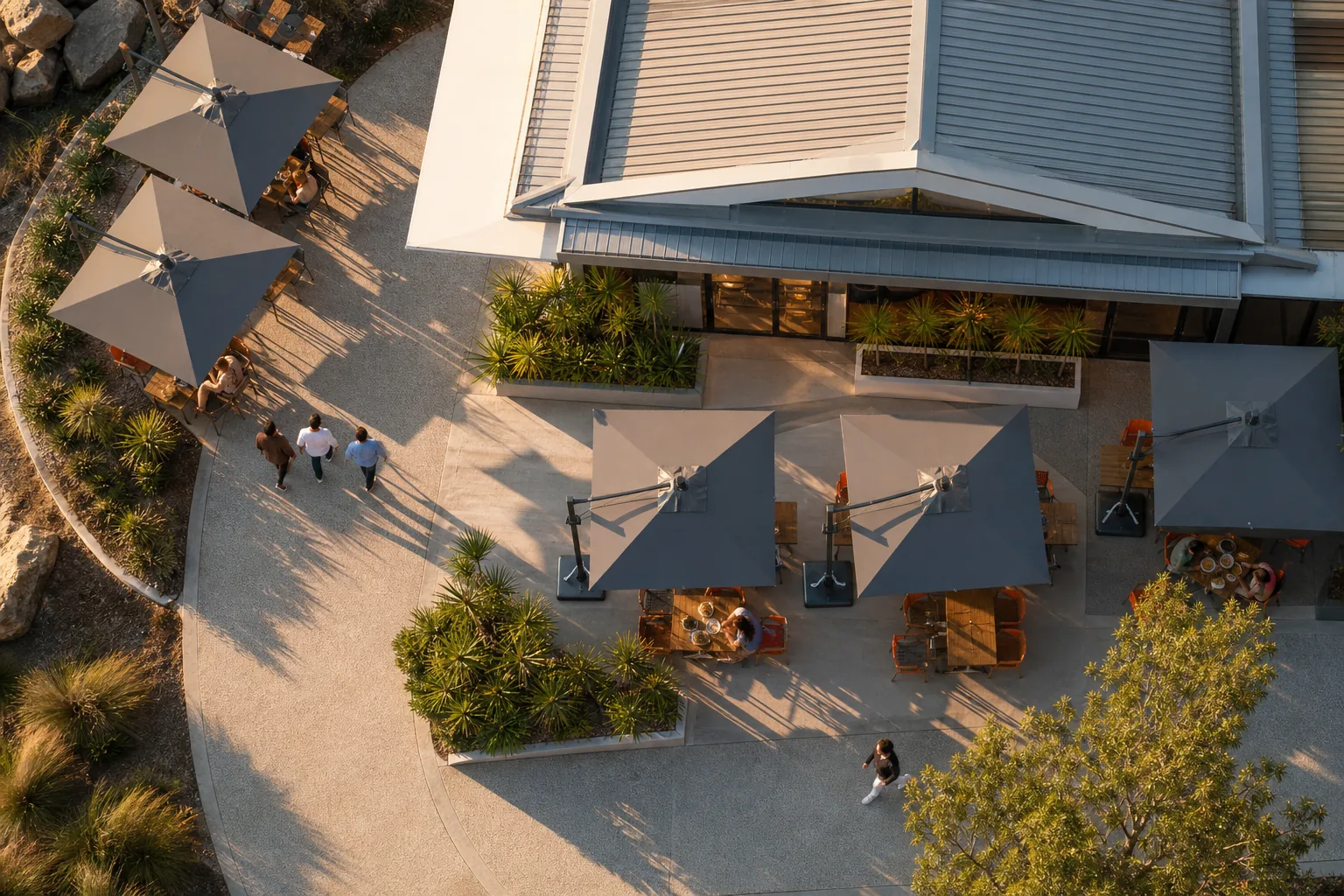
Before you approve the size, place the table plan, base footprint and opening path on the same drawing. If one of those layers is missing, the layout is not ready.
Step 5: Plan Installation, Operation and Ongoing Maintenance
Installation is part of the product specification. A strong canopy can still fail to perform if the base sits on an unsuitable surface or the anchors do not match the slab.
Confirm who will prepare the footing, install anchors and lift the umbrella into place. Large components may need more than one person and may require access for delivery equipment. Keep the installation drawing with the venue’s site records.
Write a short operating procedure for staff. It should cover opening, rotation, tilt, closing and storage. Staff should know that the umbrella must be closed when unattended or when wind conditions threaten. Wind damage may sit outside the warranty, so this step protects both people and the investment.
Schedule inspections at least every three months, and check the umbrella after a major weather event. Regular inspections are appropriate because exposure to climate and airborne pollutants varies by site.
During each inspection, look for:
- Loose fasteners or movement at the base
- Frayed stitching, stretched fabric or damaged seams
- Corrosion around fittings, especially near salt air
- Blocked drainage points or trapped debris
- Cracks, bends or unusual noise in the frame
Clean the canopy with the method approved for its fabric. Avoid storing it wet for long periods because trapped moisture can lead to mildew. Do not use a harsh chemical simply because it removes a mark quickly.
Keep a maintenance log with the inspection date, weather event, action taken and person responsible. That record helps a venue manager spot repeat faults before they become a closure or safety issue.
Step 6: Finalise the Specification with an Australian Shade Specialist
A commercial specification should bring the site findings into one clear document. Ask for a quote that names the canopy fabric, UV rating, frame material, base, fixing method, size, warranty and care requirements.
Also ask what the published performance figure means. A UPF rating relates to the fabric. A wind figure may come from a controlled test. Neither one replaces correct anchoring, staff training or closing the umbrella in severe weather.
Give the specialist these project details:
- Site address and exposure level
- Canopy size and shape under review
- Furniture plan and clear walkway width
- Surface type and possible fixing points
- Salt, pool chemical or airborne pollution exposure
- Opening hours and staff operating plan
- Required documents for the owner, builder or facility manager
Umbrello is a useful point of contact when the project needs premium shade with a clear focus on design, materials and Australian conditions. It works with hospitality venues, commercial buyers, architects, builders, schools and public-space projects. Request expert advice before the final canopy size is locked in.
For multi-site developments, procurement can become part of the work. A supplier-management guide such as software for managing suppliers and purchase orders may help teams track quotes, delivery details and landed costs when several vendors are involved.
Use a final review meeting to close the gaps. If the supplier cannot state a UV number, wind figure or warranty period, mark that limitation beside the specification rather than filling it with an assumption.
FAQ: UV Protection Cantilever Umbrellas for Commercial Use
What UV rating should a commercial cantilever umbrella have?
A commercial canopy should state a UPF rating, with UPF 50 or UPF 50+ providing a clear benchmark for comparison. The rating applies to the fabric, not the whole installation. Also check the fabric name, fade warranty, cleaning method and how much shade the canopy gives at different sun angles.
Are cantilever umbrellas suitable for windy Australian locations?
Cantilever umbrellas can suit exposed sites when the frame, base and fixing method match the conditions. Do not rely on the canopy alone. Ask for any published wind data, confirm the test conditions and use a written close-down rule. Umbrellas should be closed when unattended or when strong weather approaches.
Is acrylic fabric suitable for commercial outdoor shade?
Acrylic can be suitable for commercial outdoor shade when the supplier states its UV performance and care requirements. Umbrello’s high-end cantilever umbrella uses UV-resistant acrylic, but it does not publish a numeric rating in the available product information. Ask for the exact fabric specification and warranty before approval.
What base does a large commercial cantilever umbrella need?
A large commercial cantilever umbrella may need a bolt-down plate or in-ground footing rather than a light movable base. The correct choice depends on canopy size, surface, exposure and site access. Have the specialist confirm ballast or anchor details in the quote, then include those requirements in the installation plan.
How often should a commercial umbrella be inspected?
Inspect a commercial umbrella at least every three months and after a major weather event. Check the fabric, seams, frame, fittings and base. Coastal sites or venues with heavy daily use may need more frequent checks. Record each inspection, repair and cleaning task in the venue maintenance log.
Conclusion
Choose a commercial cantilever umbrella by matching documented UV performance with the site, base and daily operating plan. Start with a measured layout and request a written specification from Umbrello or another qualified Australian shade specialist. That one step will expose missing details before they become an installation or maintenance problem.
