


Outdoor Umbrellas
Cantilever vs Centre-Post Outdoor Umbrellas: Which One Is Right for Your Space?
Sep
Choosing the wrong umbrella for your space is one of the most common outdoor furniture mistakes Australian buyers make, and it almost always comes down to one decision: cantilever umbrella or centre-post umbrella?
These two styles look similar at a glance, but they work in completely different ways and suit completely different spaces. Getting this choice right the first time saves you money, frustration, and the hassle of starting over.
In this guide, you’ll learn exactly how each type works, what trade-offs to expect around shade coverage, base requirements, and wind performance, and which style genuinely suits your outdoor setup. By the end, you’ll have everything you need to make a confident, informed decision before you spend a single dollar.
The Umbrella That Ruined the Afternoon
Picture this: it’s a Saturday in January, the table is set, the prawns are on ice, and twelve people are crowded around your outdoor setting trying to enjoy lunch. But the sun has shifted, and the umbrella post sits dead centre of the table, meaning half the table is squinting and everyone is shuffling their chairs around a pole that’s planted exactly where elbows want to be.
Or maybe it’s the pool scenario: you bought a beautiful umbrella, set it up at the water’s edge, and realised the base sits right where the kids need to step in and out. Every. Single. Time.
Both of these are the same problem wearing different clothes. Most buyers choose an outdoor umbrella based on looks, price, or whatever’s in stock, without thinking about how the mechanism actually fits the space and the way people move through it.
That mismatch is expensive. The wrong umbrella doesn’t just annoy you; it gets replaced. And the replacement, bought after the frustration of getting it wrong the first time, almost always costs more than making the right call upfront would have.
How Each Umbrella Type Actually Works
So what actually separates these two umbrella types? It comes down to one thing: where the pole sits.
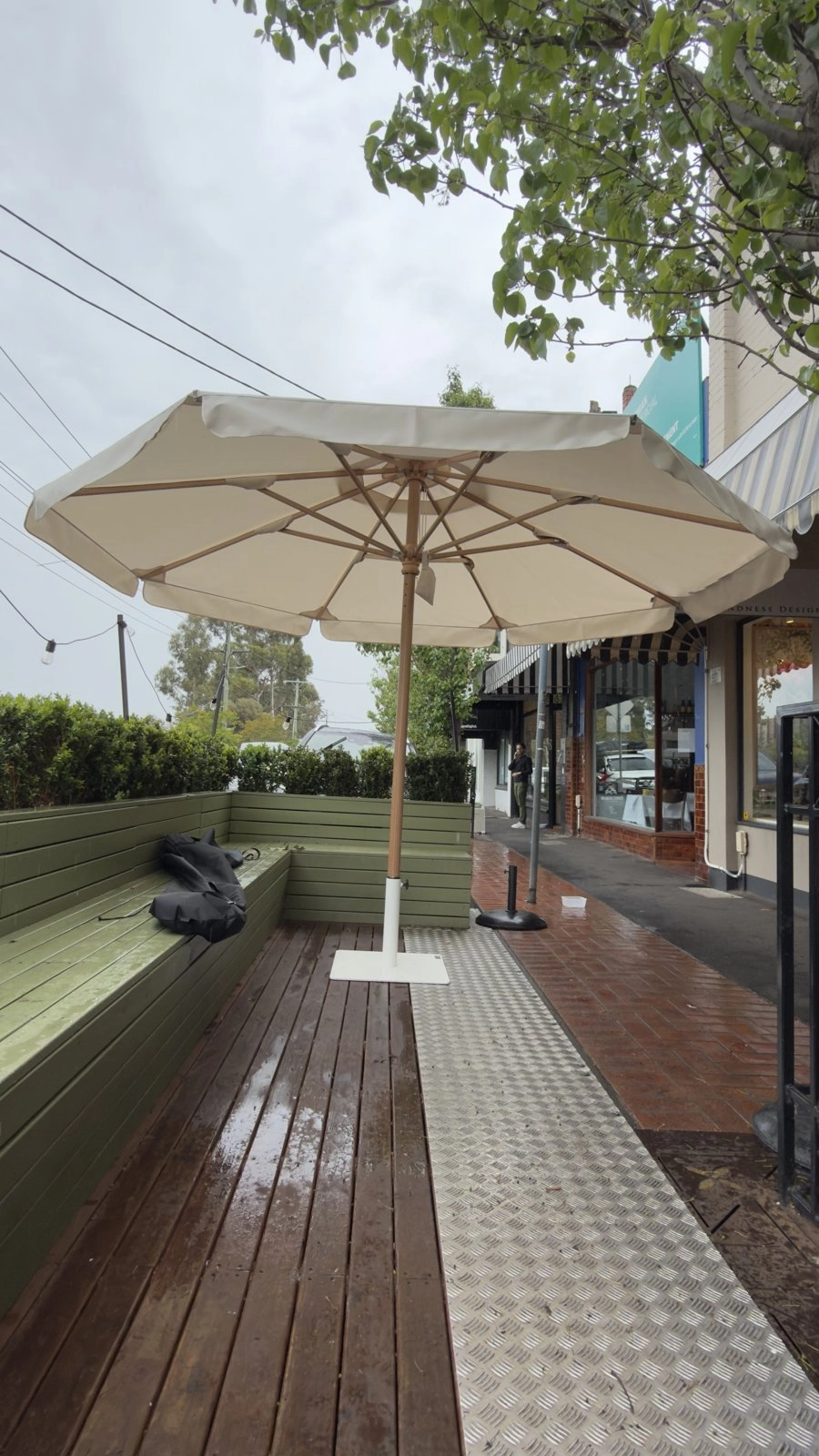
A centre-post umbrella is exactly what it sounds like. The pole runs straight up through the middle of the canopy, dropping into either a hole in your table or a freestanding weighted base. Simple, symmetrical, and inherently stable because the load travels vertically, straight down through the pole into the ground.
A cantilever umbrella (also called an offset umbrella) works differently. The pole mounts to the side, and a horizontal arm extends outward so the canopy hovers over the space with nothing underfoot. No post in the middle of your table. No obstruction at the pool edge. Just shade, exactly where you need it.
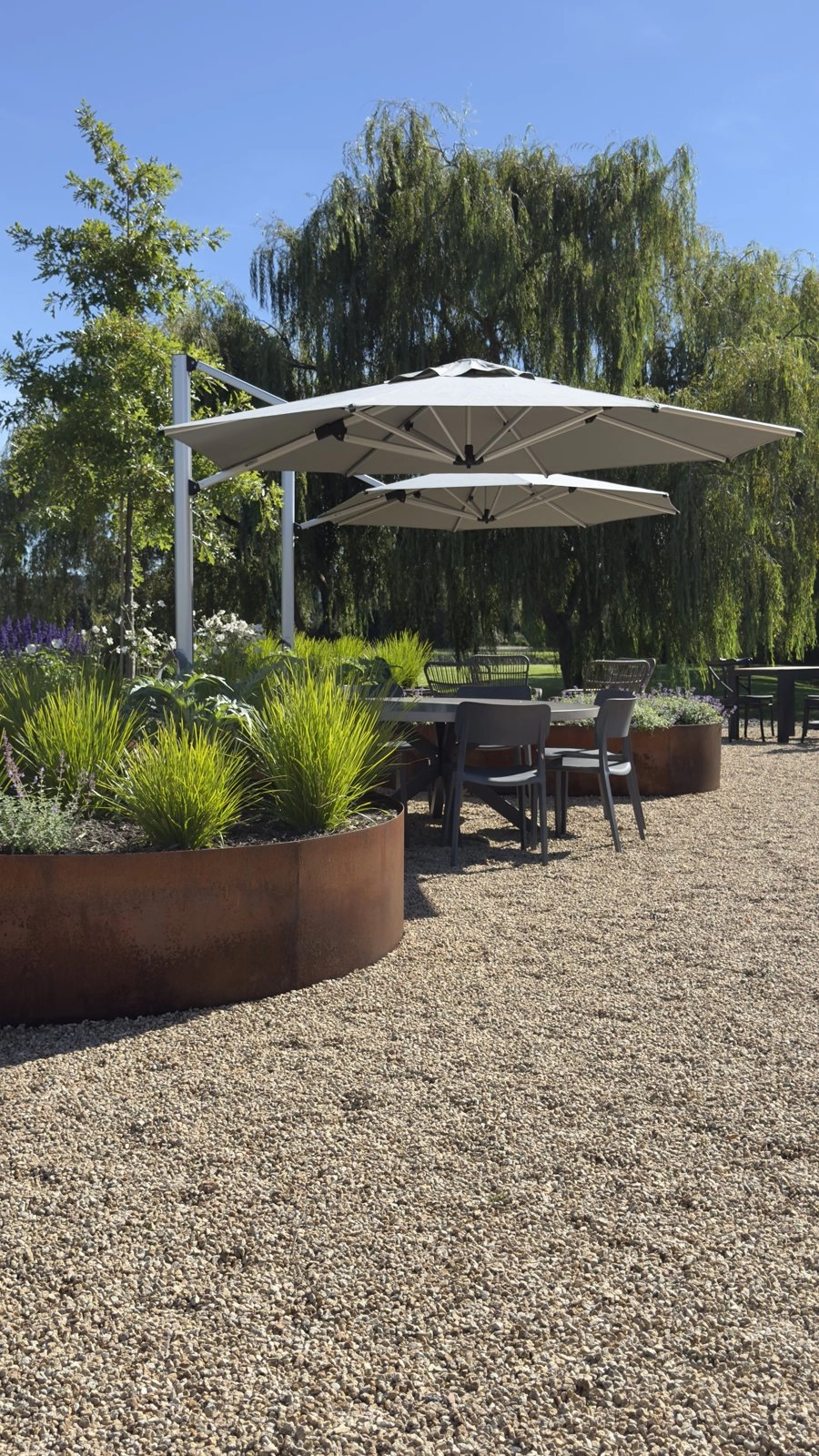
That mechanical difference matters more than most buyers realise. Because the cantilever canopy is offset from its support point, the load transfers sideways rather than straight down. That creates leverage, and leverage demands a significantly heavier or anchored base to keep everything stable. A centre-post base can be relatively modest; a cantilever base needs to work much harder.
There is a practical upside to the cantilever design, though. Most models offer 360-degree rotation and multi-angle tilt, so you can track the sun across the day without shifting your furniture. Centre-post umbrellas typically tilt, but they do not rotate independently of their base.
Every trade-off covered in this article, footprint, wind performance, base requirements, flows directly from this single mechanical distinction.
Footprint vs Shade Coverage: A Trade-Off Worth Understanding
That mechanical difference plays out immediately when you start thinking about your actual space.
A centre-post umbrella plants its pole right in the middle of the shaded zone. That sounds fine in theory, but in practice it means your furniture has to arrange itself around an obstacle, and anyone walking through ducks or sidesteps the pole constantly. For a small courtyard or a tight poolside setup, that central post genuinely eats into how freely you can use the space.
A cantilever umbrella flips this entirely. The pole stands to one side, and the canopy floats out over the area you want shaded. Nothing interrupts the shaded zone at all. That is why cantilever umbrellas work so well at pool edges, where a central post would sit exactly where people step in and out of the water, and in fixed outdoor seating arrangements where every square metre matters.
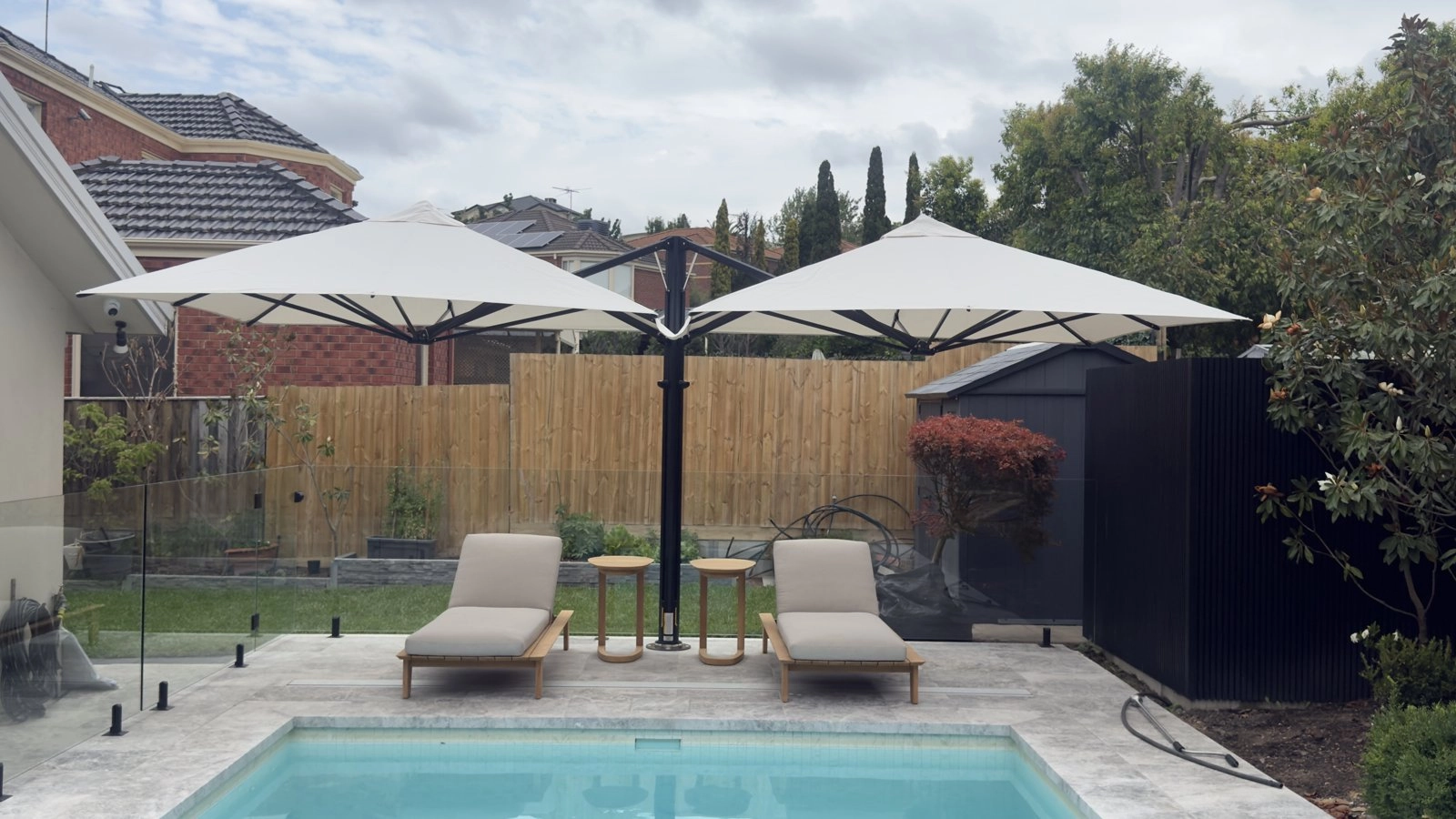
Here is the part that catches buyers off guard, though. While the shaded zone under a cantilever is completely clear, the base and support arm need room on the unshaded side. That space is not wasted, but it does need to exist. Many buyers measure only the area they want shaded, forget to account for the base clearance beside it, and end up with an installation that either crowds an adjoining wall or simply does not fit.
Before you decide, measure twice: mark out the area you want in shade, then check what space sits adjacent on one side for a base. If both zones are workable, a cantilever almost always delivers more genuinely usable ground. If the base side is hemmed in, a centre-post may suit the space better.
Base Requirements: The Part Most Buyers Underestimate
Space matters, but so does what’s holding everything up. Once you’ve settled on where the shade needs to land, the base question becomes the one that trips most buyers.
Centre-post umbrellas are forgiving on this front. Because the pole runs straight down into the base, the load transfers vertically. A quality weighted base in the 50 to 80 kg range handles most residential setups and café settings without drama.
Cantilever umbrellas are a different story entirely. The offset arm creates significant lateral leverage, and that force has to go somewhere. Freestanding ballast bases for cantilever models often weigh 150 kg or more. For larger canopies or exposed, wind-prone sites, a freestanding base may not be enough. In-ground concrete anchoring is the more reliable solution, typically requiring a concrete-filled hole around one metre deep.
That last point deserves emphasis. One metre of concrete in the ground is a permanent commitment. It changes where the umbrella lives, possibly forever. Buyers who discover this after purchase, rather than before, are rarely pleased.
The good news for homeowners who want flexibility: wheeled cantilever bases are an increasingly popular option in 2026. They let you reposition the umbrella without any ground work. The trade-off is real though; they suit calmer environments and smaller canopy sizes, not exposed coastal blocks or large commercial spans.
The base is never an afterthought. An umbrella that tips in a summer storm is not just an expensive replacement. It is a safety risk. Matching the anchoring system to the umbrella at the point of purchase is the decision that keeps everything standing when the weather turns.
Wind Performance: Which Type Holds Up in Australian Conditions?
So base weight is settled, now the question is what happens when the wind actually picks up.
The good news is that both cantilever and centre-post umbrellas can be engineered to handle serious gusts. The difference isn’t which type has better canopy fabric or stronger ribs. It’s physics.
A centre-post umbrella transfers wind load straight down through the pole into the base. The load path is direct and vertical, which is why a relatively modest weighted base handles moderate conditions without drama. A cantilever works differently. Because the canopy is offset from the anchor point, wind force acts on a lever arm. The base joint absorbs not just the weight of the canopy but the amplified rotational stress of every gust. The further the canopy extends, the greater that stress becomes.
For anyone on the Australian coast, or on an elevated block where afternoon sea breezes arrive on schedule, this matters considerably. A premium cantilever canopy rated for high winds is only half the equation. If the base isn’t sized to match, that rating is meaningless in practice. The canopy doesn’t fail. The base tips.
The practical rule is simple: always check the wind rating of the specific model, not just the umbrella type. Manufacturers publish these figures, and they’re worth comparing against the actual wind exposure of your site. A beachside deck in Queensland has different demands than a sheltered inner-city courtyard in Melbourne.
A premium canopy on an undersized base fails regardless of build quality. Match both, and either type can perform reliably through an Australian summer.
Which Umbrella Type Suits Which Space?
Now that you know what each type demands from its base and how it handles the wind, the next step is matching the mechanism to your actual space.
Pools and spa areas: A cantilever umbrella is the clear winner here. With no centre post at the water’s edge, there’s nothing to trip over or step around when getting in and out. The 360-degree rotation means you can track the sun across the day without shifting a single lounger.
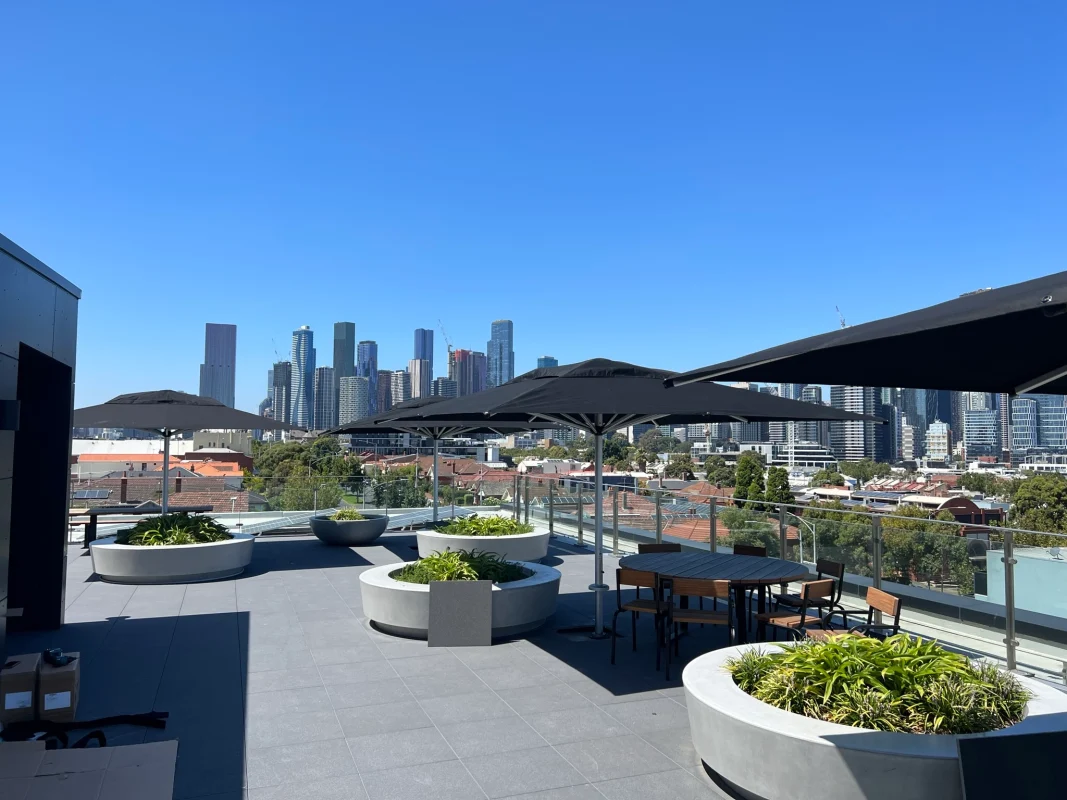
Small patios and courtyards: A cantilever umbrella makes the most of a tight space, keeping the entire shaded zone completely clear underfoot. This is a common fit for inner-city townhouses and apartments with narrow outdoor zones. Just make sure you have room on one side for the base arm before you buy.
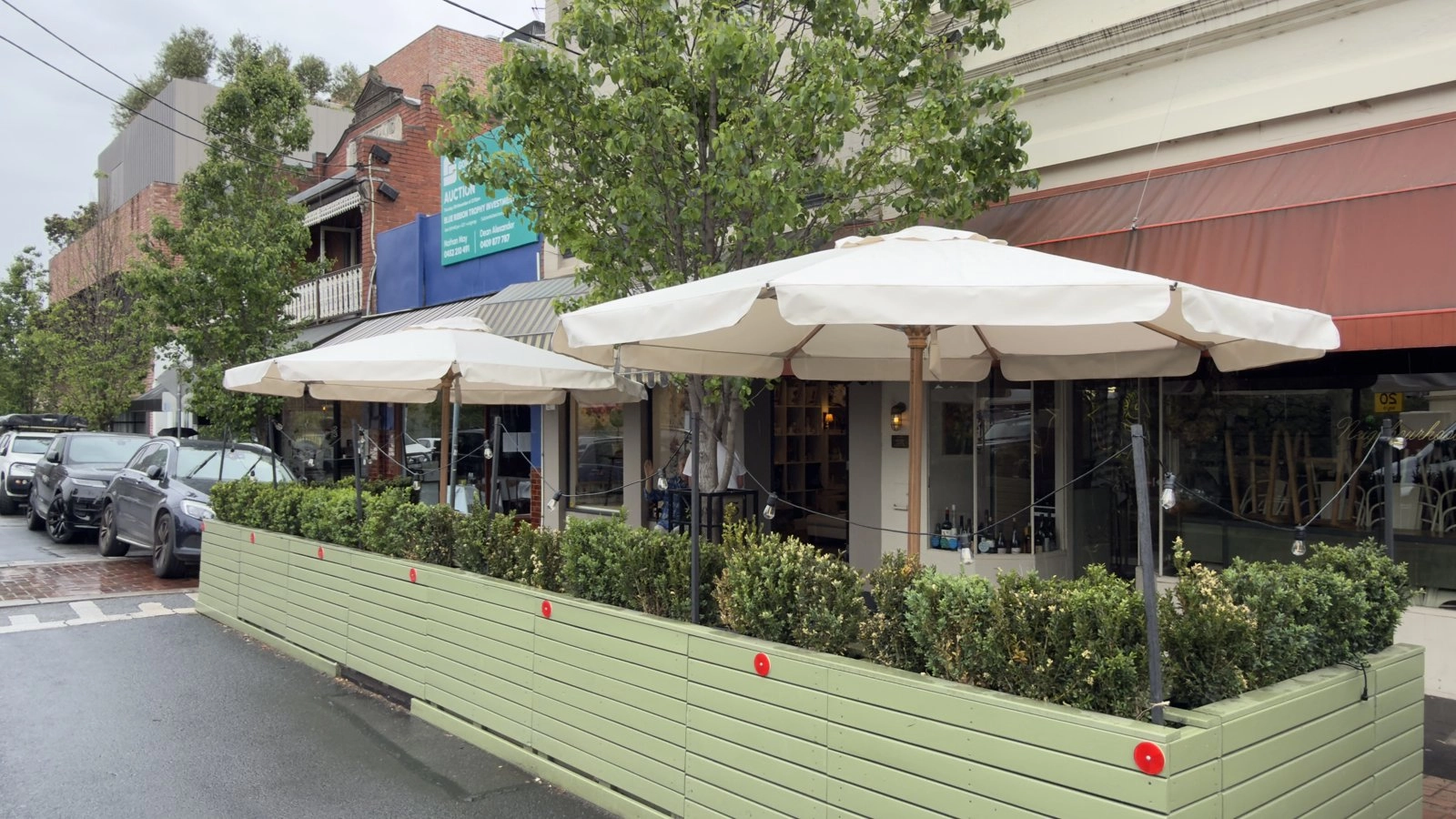
Large café and restaurant terraces: Centre-post umbrellas generally make more sense here. They’re easier to deploy across a grid of tables, base management is straightforward, and the per-unit cost is lower when you’re covering a dozen tables rather than two.
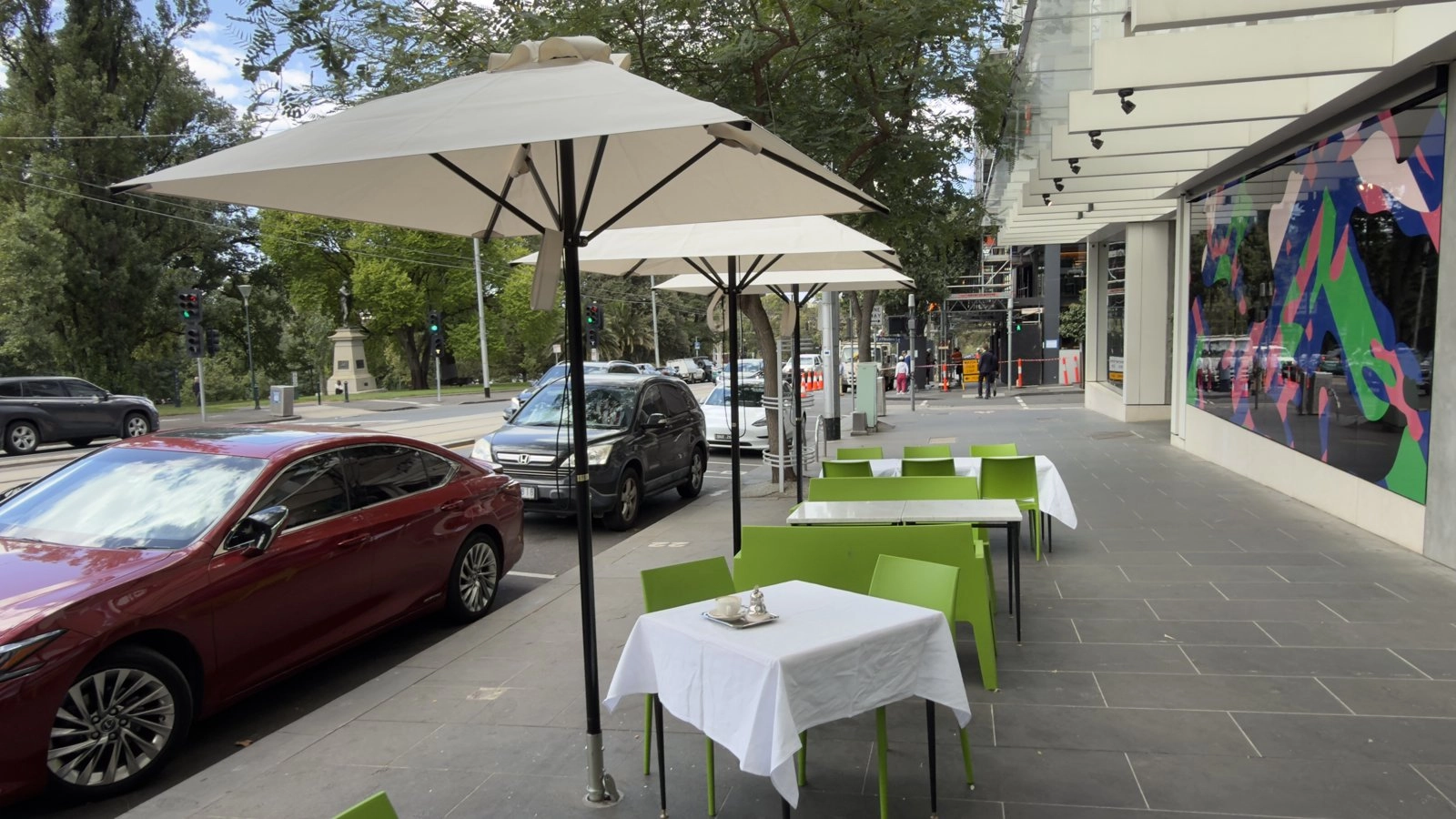
Residential decks and alfresco dining: Either type can work. If a centre post would sit awkwardly in the middle of your table setting or cut across your view, a cantilever is worth the extra base investment. If the layout accommodates a central pole comfortably, a centre-post keeps things simpler.
Permanent commercial venues: Structural or in-ground cantilever systems deliver the best durability and visual impact for venues in daily trade. Umbrello’s range includes premium Australian-made options built specifically for commercial use, not just occasional residential entertaining.
Cost, Value and What You Are Actually Paying For
Once you’ve found the right umbrella type for your space, the next question is budget, and this is where buyers often get caught out by comparing the wrong numbers.
Cantilever umbrellas cost more upfront than equivalent centre-post models. The offset arm mechanism, heavier-duty frame hardware and more complex engineering all add to the price. That’s expected, and it’s fair.
What catches people off-guard is the base. A centre-post umbrella sitting in a modest weighted base is a very different budget line to a cantilever requiring a 150 kg ballast base or a concrete-filled in-ground anchor. Always price the complete installed system, not just the canopy.
Premium umbrellas justify their price in ways cheap ones never can. The ShadowSpec models and the Woodline Papillon and Storm umbrellas distributed by Made in the Shade that Umbrello supplies use UV-stable fabrics engineered for Australian sun, robust, well-engineered frames, and warranties that mass-market options simply don’t offer. One important note: wind damage is not covered under most umbrella warranties, which makes an undersized base a genuinely costly gamble.
The real price of getting it wrong is buying twice. A centre-post umbrella that blocks pool access, or a cantilever that tips over in the first summer storm on an undersized base, both end up costing more than making the right call upfront. The replacement spend erases any initial saving.
One more thing worth factoring in for 2026: select cantilever models now include integrated battery-powered LED lighting, adding evening functionality without running power cables. If your space gets used after dark, it’s a feature worth pricing in from the start.
The Quick Decision Guide: Choose Your Umbrella in 3 Questions
All the cost and feature analysis comes down to this. Three quick questions cut through the noise.
Question 1: Does a post in the middle of your shaded zone cause a problem?
Think about a pool edge, a walkway, a dining table, or a view you don’t want broken. If a central pole would obstruct any of those, a cantilever umbrella is almost certainly the right call.
Question 2: Do you need to chase the shade without moving furniture?
If your outdoor space shifts from morning sun to afternoon glare, a cantilever with 360-degree rotation and tilt handles that without anyone lifting a chair. If one fixed position works all day, a centre-post is simpler and more cost-effective.
Question 3: What is your base situation?
Permanent in-ground installation is viable on your site: a cantilever is a strong option. Renting, on a rooftop, or needing to move the umbrella regularly: a centre-post with a weighted base is far more practical.
Bonus for venue operators: Centre-post umbrellas are easier to deploy across multiple tables at scale. But a well-positioned cantilever installation can become the visual centrepiece guests photograph and remember, giving your venue an edge that a row of matching poles simply does not.
If you answered yes to Question 1 or 2, start with cantilevers. If you answered yes to Question 3’s second scenario, start with centre-post.
Frequently Asked Questions
What is the difference between a cantilever and a centre-post umbrella?
A centre-post umbrella has its pole running up through the middle of the canopy, into a table or a weighted base. A cantilever (offset) umbrella has its pole to one side, with an arm holding the canopy out over the area, so the shaded space underneath stays completely clear.
How heavy does a cantilever umbrella base need to be?
Much heavier than a centre-post base. Because the offset arm creates leverage, freestanding cantilever bases often need 150 kg or more of ballast. For large canopies or exposed, windy sites, an in-ground concrete footing is the more reliable option. Always follow the base specification for your specific model.
Which umbrella is best around a pool?
A cantilever. With no centre pole at the water’s edge, nothing gets in the way of people stepping in and out, and 360-degree rotation lets you follow the sun without moving the loungers.
Are cantilever umbrellas safe in windy conditions?
Yes, provided the base is matched to the umbrella. Wind acts on the offset arm like a lever, so an undersized base, not the canopy, is the usual point of failure. Check the wind rating of the specific model and size the base or footing to suit your site’s exposure.
Should a café or restaurant choose centre-post or cantilever umbrellas?
For covering lots of tables, centre-post umbrellas are usually simpler to manage and cheaper per table. For a permanent feature over a key area, a commercial cantilever on an in-ground footing gives clear space underneath and strong visual impact.
The Right Umbrella Makes the Space, and Lasts
Neither umbrella type wins outright. One fits your space; the other doesn’t. Get it right and you barely think about your umbrella again. Get it wrong and you’re shopping for a replacement before the next summer rolls around.
The decision comes down to four things: footprint and obstruction, base commitment, wind exposure, and how you actually use the space day to day. Work through those honestly and the right choice becomes obvious.
On investment: premium umbrellas from established suppliers are not cheap. They’re also not built to survive one Australian summer and fade quietly into the bin. The ShadowSpec range, Woodline’s Papillon and Storm umbrellas (distributed by Made in the Shade) and the Australian-made options Umbrello carries are engineered for the heat, the UV and the storms that come with this climate, season after season. Cheap umbrellas cost less once. Quality umbrellas cost less over time.
If you’d rather get a tailored recommendation than piece it together from a product page, the Umbrello team can help. We work with homeowners and venue operators across Melbourne, Sydney and Brisbane, matching the right umbrella to each specific space based on real site conditions, not guesswork.
Request a quote and get advice built around your outdoor area. Buy once, buy right.
Frequently Asked Questions
What is the difference between a cantilever and a centre-post umbrella?
A centre-post umbrella has its pole running up through the middle of the canopy, into a table or a weighted base. A cantilever (offset) umbrella has its pole to one side, with an arm holding the canopy out over the area, so the shaded space underneath stays completely clear.

My garden table setup is always cramped by the centre pole, so this is brilliant for helping me finally choose a cantilever style for the patio.